MCQ
$Nd ^{2+}=$
  • A
    $4 f^2 6 s^2$
  • $4 f^4$
  • C
    $4 f^3$
  • D
    $4 f ^4 6 s ^2$

Answer

Correct option: B.
$4 f^4$
b
$Nd (60)=[ Xe ] 4 f ^4 5 d ^0 6 s ^2$

$Nd ^{2+}=[ Xe ] 4 f ^4 5 d ^0 5 s ^0$

Need a full question paper?

Generate a complete, print-ready paper with questions like this in minutes — across 16+ boards, with answer keys.

Start Generating Free

Similar questions

Mass of ethylene glycol (antifreeze) to be added to $18.6 \mathrm{~kg}$ of water to protect the freezing point at $-24^{\circ} \mathrm{C}$ is__________ $\mathrm{kg}$ (Molar mass in $\mathrm{g} \mathrm{mol}^{-1}$ for ethylene glycol $62, \mathrm{~K}_{\mathrm{f}}$ of water $=1.86 \mathrm{~K} \mathrm{~kg} \mathrm{~mol}^{-1}$ )
A carbonyl compound ${P}$, which gives positive iodoform test, undergoes reaction with $\mathrm{MeMgBr}$ followed by dehydration to give an olefin ${Q}$. Ozonolysis of ${Q}$ leads to a dicarbonyl compound ${R}$, which undergoes intramolecular aldol reaction to give predominantly ${S}$.

${P} \xrightarrow[\substack{\text { 2. } \mathrm{H}^{+}, \mathrm{H}_2 \mathrm{O} \\ \text { 3. } \mathrm{H}_2 \mathrm{SO}_4, \Delta}]{\text { 1. MeMgBr }}Q \xrightarrow[\text { 2. } \mathrm{Zn}, \mathrm{H}_2 \mathrm{O}]{1 . \mathrm{O}_3} {R} \xrightarrow[\text { 2. } \Delta]{1 . \mathrm{OH}^{-}} {S}$

$1.$ The structure of the carbonyl compound ${P}$ is

$Image$

$2.$ The structures of the products ${Q}$ and ${R}$, respectively, are

$Image$

$3.$ The structure of the product ${S}$ is

$Image$

Give hte answer question $1,2$ and $3.$
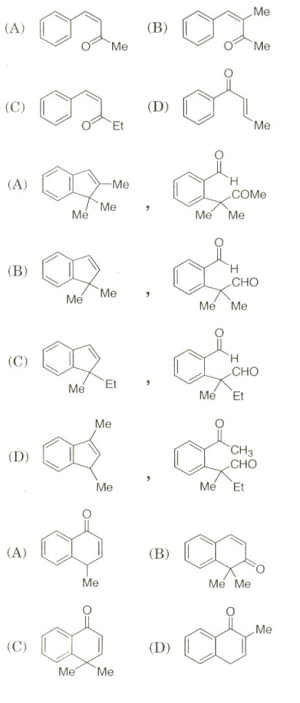
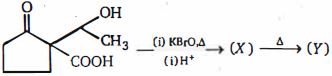
Hence the product $(Y)$ in the above sequence of reactions, is
For the reaction $A + B =2 C$, the speed of extinction of A is $10^{-2}$ mole litre 'second', then what will be the speed of formation of C ?
On the basis of position in the electrochemical series, the metal which does not displace hydrogen from water and acid is
Which of the following diazonium salt is relatively stable of $0-5\,^o C$ :
Figure $\xrightarrow{{{H^ + }/{H_2}O}}P$

Figure $\xrightarrow[{(ii)\,\,NaB{D_4}}]{{(i)\,\,Hg{{(OAc)}_2}\,{H_2}O}}Q$

Figure $\xrightarrow[{(ii)\,\,{H_2}{O_2}\,/\,O{H^ - }}]{{(i)\,\,B{D_6}\,,\,THF}}R$

 Products $P, Q$ and $R$ are
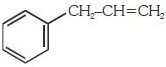
In nucleuphilic substitution reaction, order of halogens as incoming (attacking) nucleophile is:
$I^-> Br^ - > Cl^-$
The order of halogens as departing nucleophile should be
$\xrightarrow[{B{r_2}}]{{O\mathop H\limits^ \ominus  }} \, ;$ Intermediate of the given reaction is/are
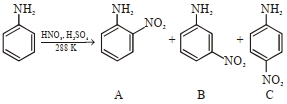
Consider the given reaction, percentage yield of :