MCQ
Nesseler's reagent is
  • A
    ${K_2}Hg{I_4}$
  • ${K_2}Hg{I_4} + KOH$
  • C
    ${K_2}Hg{I_2} + KOH$
  • D
    ${K_2}Hg{I_4} + Hg$

Answer

Correct option: B.
${K_2}Hg{I_4} + KOH$
(b)$2KI + Hg{I_2} \to \mathop {{K_2}Hg{l_4} + KOH}\limits_{\atop\{\rm{Nessler's reagent}}\} $


Need a full question paper?

Generate a complete, print-ready paper with questions like this in minutes — across 16+ boards, with answer keys.

Start Generating Free

Similar questions

For the reaction $PC{l_3}(g) + C{l_2}(g)$ $\rightleftharpoons$ $PC{l_5}(g)$ the position of equilibrium can be shifted to the right by
For a spontaneous process, the correct statement is
Match List $I$ with List $II$ :

LIST $I$

(Compound)

LIST $II$ (Uses) 
$A$ Iodoform $I$ Fire extinguisher
$B$ Carbon tetrachloride $II$ Insecticide
$C$ $CFC$ $III$ Antiseptic
$D$ $DDT$ $IV$ Refrigerants

Choose the correct answer from the options given below :

The species with spin only magetic moment of $\sqrt{24} \,BM$ is
An organic compound is subjected to chlorination to get compound A using $5.0\, \mathrm{~g}$ of chlorine. When $0.5\, \mathrm{~g}$ of compound $\mathrm{A}$ is reacted with $\mathrm{AgNO}_{3}$ [Carius Method], the percentage of chlorine in compound $A$ is $.....$ when it forms $0.3849$ $g$ of $\mathrm{AgCl}$. (Round off to the Nearest Integer)

(Atomic masses of $\mathrm{Ag}$ and $\mathrm{Cl}$ are $107.87$ and $35.5$ respectively)

Number of cyclic tripeptides formed with $2$ amino acids $A$ and $B$ is:
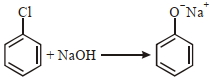
${image}$

The above reaction requires which of the following reaction conditions ?
The decomposition of ${N_2}{O_5}$ occurs as, $2{N_2}{O_5} \to 4N{O_2} + {O_2}$, and follows first order kinetics, hence
Elimination reaction of $2 -$Bromo-pentane to form pent$-2-$ene is:

$(a)$ $\beta$ $-$Elimination reaction

$(b)$ Follow Zaitsev rule

$(c)$ Dehydrohalogenation reaction

$(d)$ Dehydration reaction

The value of $K _{ C }$ is $64$ at $800\, K$ for the reaction $N _{2}( g )+3 H _{2}( g ) \rightleftharpoons 2 NH _{3}( g )$

The value of $K _{ C }$ for the following reaction is :

$NH_{3}(g) \rightleftharpoons \frac{1}{2} N _{2}(g)+\frac{3}{2} H_{2}(g)$