MCQ
Newton-second is the unit of
  • A
    Velocity
  • B
    Angular momentum
  • Momentum
  • D
    Energy

Answer

Correct option: C.
Momentum
c
(c) Impulse $=$ change in momentum $= F \times t$

So the unit of momentum will be equal to Newton-sec.

Need a full question paper?

Generate a complete, print-ready paper with questions like this in minutes — across 16+ boards, with answer keys.
Start Generating Free

Similar questions

A bullet of mass $10\,g$ moving horizontally with a velocity of $400\, m/s$ strikes a wooden block of mass $2\, kg$ which is suspended by a light inextensible string of length $5\, m$. As a result, the centre of gravity of the block is found to rise a vertical distance of $10\, cm$. The speed of the bullet after it emerges out horizontally from the block will be ............... $\mathrm{m}/ \mathrm{s}$
A ball is projected with kinetic energy $E$ at an angle of ${45^o}$ to the horizontal. At the highest point during its flight, its kinetic energy will be
If the earth stops rotating, the value of $‘g’$ at the equator will
$100 \,g$ of a iron ball having velocity $10 \,m/s$ collides with a wall at an angle ${30^o}$ and rebounds with the same angle. If the period of contact between the ball and wall is $0.1 \,second$, then the force experienced by the ball is ............. $\mathrm{N}$
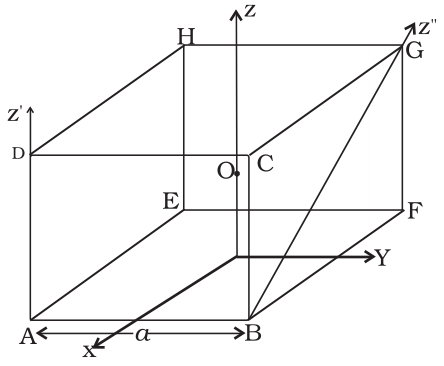
With reference to of a cube of edge a and mass m, state whether the following are true or false. (O is the centre of the cube.)

A body of mass $2\,kg$ is moving with velocity $10 \,m/s$ towards east. Another body of same mass and same velocity moving towards north collides with former and coalsces and moves towards north-east. Its velocity is
Internal energy of a non-ideal gas depends on ..........
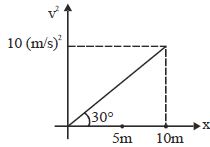
Find the acceleration of particle at $x = 5\,m$ with the help of graph. where $v-$ velocity and $x-$ displacement
A particle excutes $SHM$ on a straight line path. The amplitude of oscillation is $2\,cm$. When the displacement of the particle from the mean position is $1\,cm$, the numerical value of magnitude of acceleration is equal to the numerical value of magnitude of velocity. The frequency of $SHM$ is (in $second^{-1}$)
Choose the wrong option.
  1. Inertial mass is a measure of difficulty of accelerating a body by an external force whereas the gravitational mass is relevant in determining the gravitational force on it by an external mass.
  2. That the gravitational mass and inertial mass are equal is an experimental result.
  3. That the acceleration due to gravity on earth is the same for all bodies is due to the equality of gravitational mass and inertial mass.
  4. Gravitational mass of a particle like proton can depend on the presence of neighouring heavy objects but the inertial mass cannot.