MCQ
Nisha performs an experiment with two potted plants. She keeps the pots in sunlight and waters
them equally. She adds manure to the soil in Pot $1.$
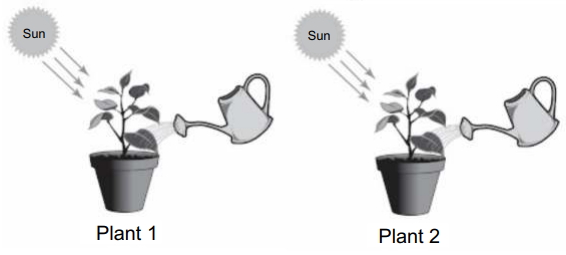
Image
She creates a table to record her observations.
  Manure added Height of the plant at the start of the experiment Height of the plant after $4$ weeks
Plant $1$ Yes $..........$ $..........$
Plant $2$ no $..........$ $..........$
$10.$ What is Nisha investigating?
  • A
    Does manure make soil porous?
  • Does manure help plants grow better?
  • C
    Do plants need sunlight and water to grow?
  • D
     Is manure better than chemical fertilisers for plant growth?
Answer

Correct option: B.
Does manure help plants grow better?

Need a full question paper?

Generate a complete, print-ready paper with questions like this in minutes — across 16+ boards, with answer keys.

Start Generating Free

Similar questions

The $5\ R$ principle is about environment - friendly practices.
The key components of the principle are as follows.
● Reuse
● Refuse
● Reduce
● Recycle
● Recover
$10.$ The government advises people to stop using plastic bags for grocery shopping.
Which component of the $5\ R$ principle is this advice related to$?$

 
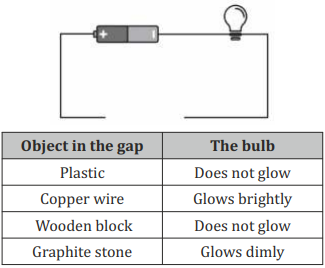
Tia used four different objects to ill the gap in an electric circuit, separately.
The table shows what she found.
Image
$1.$ Which of these best conducts electricity$?$
$A.$ Wood
$B.$ Plastic
$C.$ Copper
$D.$ Graphite
$2$. Which of these is a chemical effect of electric current$?$
$A.$ Glowing of bulb
$B.$ Heating of water
$C.$ Ringing of mobile phone
$D.$ Chromium plating on iron
$3.$ Which of these is a correct pair of an insulator and a conductor$?$
  Insulator Conductor
$A.$ Aluminium Cotton
$B.$ Thermocol Rubber
$C.$ Copper Iron
$D.$ Wax Aluminium
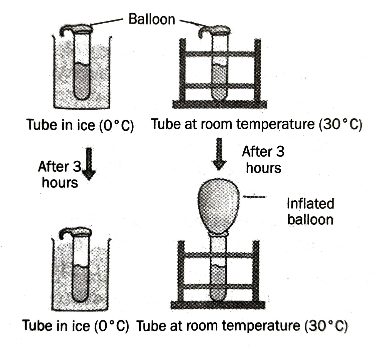
Manoj adds some yeast to two test tubes containing sugar solution. He ties balloons on the mouth of each of test tube. One test tube is kept in ice and the other at room temperature. The picture shows what happens after three hours.
Image
(i) What is Manoj investigating ?
$\quad$(a) Does yeast grow in sugar solution only ?
$\quad$(b) Does yeast convert sugar into alcohol ?
$\quad$(c) Does temperature affect the growth of yeast ?
$\quad$(d) Which gas is produced as yeast grows in sugar solution ?
(ii) How can Manoj confirm, if the gas produced in the test tube at room temperature was due to the yeast growing in it ?
$\quad$(a) He should repeat the same experiment
$\quad$(b) He should leave the test tube undisturbed for six hours
$\quad$(c) He should repeat the experiment with test tubes containing more sugar solution
$\quad$(d) He should keep an extra set of test tubes with sugar solution, but without the yeast
(iii) What should Manoj keep the same in both the test tubes for a fair experiment? Circle 'Yes' or 'No' for each row.
Should this be kept same for both the test tubes ?Yes or No
(a) The concentration of sugar solutionYes/No
(b) The colour of the balloonsYes/No
(c) The amount of yeast added to each test tubeYes/No

(iv) What type of organism is yeast ?

$\quad$(a) Fungi
$\quad$(b) Algae
$\quad$(c) Bacteria
$\quad$(d) Protozoa
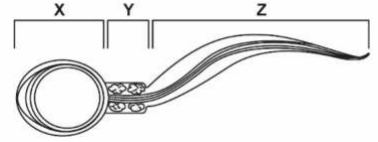
The picture shows the basic parts of a salmon ish sperm.

Image
$7.$ Which part of the sperm helps it to swim in water and reach the egg$?$
$8.$ Which of these animals reproduce by external fertilization?
$A.$ Snake
$B.$ Frog
$C.$ Horse
$D.$ Elephant
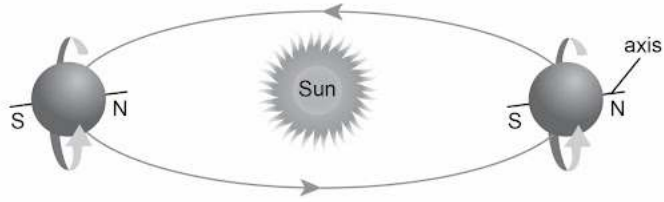
The diagram shows how a planet rotates on its axis as it revolves around the Sun.Image
$9.$ What can be concluded about the planet from the diagram?
Can this be concluded from the diagram? Yes or No
The planet rotates from east to west. Yes/No
The planet does not experience change of seasons. Yes/No
The planet rolls on its orbit as it revolves around the Sun. Yes/No
$10.$ What is the word used for a celestial object that has a bright head and a long tail?
$A.$ Comet
$B.$ Meteor
$C. $ Asteroid
$D.$  Meteorite
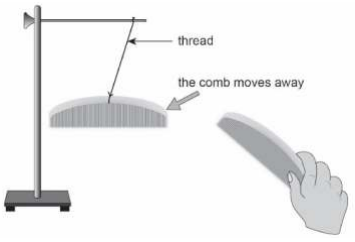
Ryan ran two combs through his hair.
He hung one comb from a stand using a thread.
Ryan brought the other comb close to the irst comb.
The picture below shows the result.
Image

$1.$ Why did the comb move away from the other$?$
$2.$ Ryan repeats the activity using a pair of glass rods in place of the combs.
What would be the result$?$
$A.$ The hanging rod will move away
$B.$ The hanging rod will come closer
$C. $ The hanging rod will show no change
$D. $ The hanging rod will start spinning
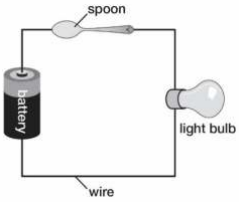
Sajid has four teaspoons made of different materials.
He used each spoon to close an electric circuit one by one.
Image

The table below shows if the light bulb glows for each spoon in the circuit.
Spoon in the circuit Does the light bulb glow?
Spoon $1$ No
Spoon $2$ No
Spoon $3$ Yes
Spoon $4$ Yes
$1.$ Which of these is supported by the results of Sajid’s activity$?$
$A.$ Spoon $1$ is made of metal and Spoon $2$ is made of non-metal
$B.$ Spoon $2$ is made of metal and Spoon $3$ is made of non-metal
$C.$ Spoon $3$ is made of metal and Spoon $4$ is made of non-metal
$D.$ Spoon $4$ is made of metal and Spoon $1$ is made of non-metal
$2.$ Will the results of the activity change if two batteries are used in the circuit in place of the single battery? Explain your answer.
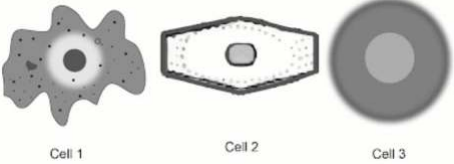
The picture shows three types of cells.
Image
$3.$ Which cell is most likelyto be an amoeba$?$
$4.$ Which of these is the correct order of arrangement from smallest to largest$?$
$A.$ cell$\rightarrow $organ$\rightarrow $tissue
$B.$ tissue$\rightarrow $cell$\rightarrow $organ
$C.$ cell$\rightarrow $tissue$\rightarrow $organ
$D.$ organ$\rightarrow $tissue$\rightarrow $cell
$5.$ Which scientist discovered cells in living organisms$?$
$A.$ Louis Pasteur
$B$. Robert Hooke
$C.$ Gregor Mendel
$D.$ Charles Darwin
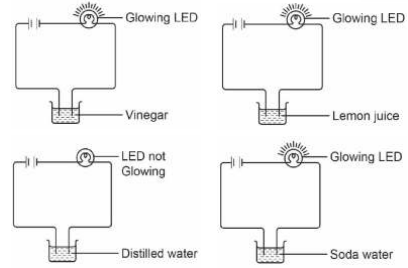
Rashmi made separate electric circuits with four different solutions.
The pictures show what she found.
Image

$4.$ What can be concluded from her activity$?$
$A. LED$ glows only in solutions
$B.$ All four solutions are insulators of electricity
$C.$ All four solutions are good conductors of electricity
$D.$ Acids and bases are good conductors of electricity
$5.$ Which safety precaution must Rashmi follow while doing this activity$?$
$A.$ Wear boots
$B.$ Wear goggles
$C.$ Wear headphones
$D.$ Wear rubber gloves
$6.$ Will an electric device work if we place the positive terminal of a battery towards the negative point of the device? Explain your answer.
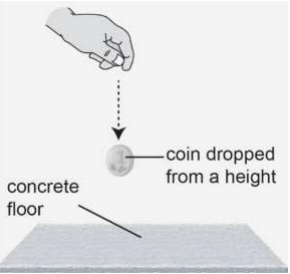
Mayank dropped four coins from the same height onto a concrete floor.
Image

The table below shows the type of sound that each coin produced after hitting the floor.
Coin Temperature of the ball when heated for a minute
Coin $1$ Ringing sound
Coin $2$ Damp sound
Coin $3$ Damp sound
Coin $4$ Ringing sound
$9.$ Which coins in Mayank’s activity are made of metal$?$
$A.$ Coin $1$ and Coin $2$
$B.$ Coin $2$ and Coin $3$
$C.$ Coin $3$ and Coin $4$
$D$. Coin $4$ and Coin $1$
$10.$ On which type of loor will Mayank’s activity produce the same results$?$
$A.$ Glass
$B.$ Sand
$C.$ Grass
$D.$ Carpet