Question
Nitrogen has positive electron gain enthalpy whereas oxygen has negative. However, oxygen has lower ionisation enthalpy than nitrogen. Explain.

Answer

Electronic configuration:
$\mathrm{N}=1 s^2 2 s^2 2 p^3$
$\mathrm{O}=1 s^2 2 s^2 2 p^4$
Nitrogen has a stable configuration with half filled 2p orbitals. Therefore, its ionisation enthalpy is more than oxygen.
Due to the presence of half filled 2p orbitals, nitrogen donot possess the tendency to gain electrons. Thus energy has to be supplied to nitrogen atom for gaining an electron. Thus, it has a positive electron gain enthalpy.
Oxygen on the other hand has a tendency to gain electrons. Thus energy would be released while gaining an electron. So, electron gain enthlapy of oxygen is negative.
​So, it can be concluded that an atom having higher ionisation enthalpy does not necessarily have a negative electron gain enthalpy.

Need a full question paper?

Generate a complete, print-ready paper with questions like this in minutes — across 16+ boards, with answer keys.
Start Generating Free

Similar questions

1. Will $CCl _4$ give a white precipitate of AgCl on heating it with $AgNO _3$ ?
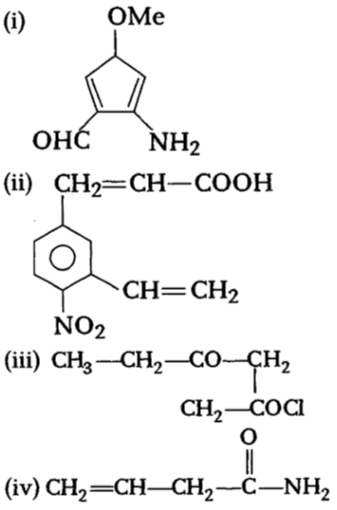
2. Identify the functional groups present in the following compounds.
Image
  1. What is the total number of electrons in $\text{NO}^-_3$ and $\text{NH}^+_4?$
  2. Why is melting point of $MgO (2800^\circ C)$ higher than that of BaO (1920°C)?
  3. Why is solubility of MgCl, greater than that of $MgF_2$?
  4. Why are carbon-oxygen bond lengths in $Na_2CO_3$ equal?
  5. Why is $AlF_3$ high melting solid whereas $SiF_4$ is a gas?
Show that the circumference of the Bohr orbit for the hydrogen atom is an integral multiple of the de Broglie wavelength associated with the electron revolving around the orbit.
  1. Give reasons for the following:
  1. Conc. $HNO_3$ can be transported in Al container.
  2. Diamond is used as an abrasive.
  1. What happens when borax is heated strongly?
  2. What is the state of hybridization of C in:,
    1. $\text{CO}^{2-}_3$
    2. Diamond?
Using electron transfer concept, identify the oxidant and reductant in the following redox reactions.
  1. $\text{Zn(s)}+2\text{H}^+\text{(aq)}\xrightarrow{\ \ \ \ \ \ \ \ \ }\text{Zn}^{2+}\text{(aq)}+\text{H}_2\text{(g)}$
  2. $2[\text{Fe}(\text{CN})_6]^{4-}\text{(aq)}+\text{H}_2\text{O}_2\text{(aq)}+2\text{H}^+\text{(aq)}\\\xrightarrow{\ \ \ \ \ \ }2[\text{Fe}\text{(CN)}_6]^{3-}\text{(aq)}+2\text{H}_2\text{O}\text{(l)}$
  3. $2[\text{Fe(CN)}_6]^{3-}\text{(aq)}+2\text{OH}^-\text{(aq)}+\text{H}_2\text{O}_2(\text{aq})\\\xrightarrow{\ \ \ \ \ \ \ \ }2[\text{Fe(CN)}_6]^{4-}\text{(aq)}+\text{O}_2 (\text{g}) +2\text{H}_2\text{(l)}$
  4. $\text{BrO}^-_3\text{(aq)}+\text{F}_2\text{(g)}+\text{2OH}^-\text{(aq)}\xrightarrow{\ \ \ \ \ \ \ \ }\\\text{BrO}^-_4\text{(aq)}+\text{F}^-\text{(aq)}+\text{H}_2\text{O(l)}$
  5. $2\text{NaClO}_3(\text{aq})+\text{I}_2\text{(aq)}\xrightarrow{\ \ \ \ \ \ \ }\text{2NaIO}_3\text{(aq)}+\text{Cl}_2\text{(g)}$
What is called electrovalent bond? Describe the circumstances necessary for the formation of ionic bond.
Match Column I with Column II.
 
Column I
 
Column II
(i)
Dumas method.
(a)
$\mathrm{AgNO}_3$
(ii)
Kjeldahl’s method.
(b)
Silica gel.
(iii)
Carius method.
(c)
Nitrogen gas.
(iv)
Chromatography
(d)
Free radicals.
(v)
Homolysis
(e)
Ammonium sulphate.
Explain different definitions of oxidation and reduction processess with example.
  1. Consider the following redox reaction that produce electricity in a galvanic cell:
    1. $2\text{Fe}^{3+}+2\text{Cl}^-\xrightarrow{ \ \ \ \ \ \ \ \ \\ }2\text{Fe}^2+\text{Cl}_2\text{(g)}$
    2. $\text{Cd}\text{(s)}+\text{I}_2\xrightarrow{ \ \ \ \ \ \ \ }\text{Cd}^{2+}+2\text{I}^-$
    3. $2\text{Cr}\text{s}+3\text{Cu}^{2+}\xrightarrow{ \ \ \ \ \ \ \\ \ \ }+3\text{Cu}\text{(s)}+2\text{Cr}^{3+}$
Write the anode and cathode reaction for galvanic cell.
  1. Split the following redox reaction into the oxidation and reduction hay reactions:
    1. $\text{Zn}+\text{Cu}^{2+}\xrightarrow{ \ \ \ \ \ \ \ \\}2\text{n}^{2+}+\text{Cu} $
    2. $\text{Sn}^2+2\text{Hg}^+\xrightarrow{ \ \ \ \\ \ \ \ }\text{Sn}^{4+}+\text{Hg}_2^{2+}$
Ozone is a toxic gas and is a strong oxidising agent even then its presence in the stratosphere is very important. Explain what would happen if ozone from this region is completely removed?