MCQ
No current flows between two charged bodies connected together when they have the same
  • A
    Capacitance or $\frac QV$ ratio
  • B
    Charge
  • C
    Resistance
  • Potential or $\frac QC$ ratio

Answer

Correct option: D.
Potential or $\frac QC$ ratio

Need a full question paper?

Generate a complete, print-ready paper with questions like this in minutes — across 16+ boards, with answer keys.
Start Generating Free

Similar questions

Rydberg’s constant is:
Two identical lights sources $S_1$​ and $S_2$​ emit the light of same wavelength $\lambda$. These light rays will exhibit interference if:
The period of oscillation of a vibration magnetometer depends on which of the following factors(a) I and M only(b) M and H only(c) I and H only(d) I, M and H only
       
A person sees his virtual image by holding a mirror very close to the face. When he moves the mirror away from his face, the image becomes inverted. What type of mirror he is using(a) Plane mirror(b) Convex mirror(c) Concave mirror(d) None of these
       
A particle moves in the X - Y plane according to the equation $\overrightarrow{\text{r}}=\Big(\overrightarrow{\text{i}}+2\overrightarrow{\text{j}}\Big)\text{A}\cos\omega\text{t}.$ The motion of the particle is:
  1. On a straight line.
  2. On an ellipse.
  3. Periodic.
  4. Simple harmonic.
In the Boolean algebra, the following one is wrong:
Black hole is a (a) Hole in the ozone layer of atmosphere(b) Hole in earth's centre(c) Highly dense matter available in the atmosphere(d) Hole in troposphere 


In a transformer the primary has 500 turns and secondary has 50 turns. 100 volts are applied to the primary coil, the voltage developed in the secondary will be(a) 1 V(b) 10 V(c) 1000 V(d) 10000 V
       
Which of the following shown particle nature of light(a) Refraction(b) Interference(c) Polarization(d) Photoelectric effect
       
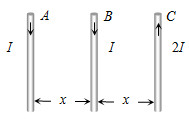
$A, B$ and $C$ are parallel conductors of equal length carrying currents $I, I$ and $2 I$ respectively. Distance between $A$ and $B$ is $x$. Distance between $B$ and $C$ is also $x .F_1$ is the force exerted by $B$ on $A$ and $\mathrm{F}_2$ is the force exerted by $B$ on $A$ choose the correct answer