MCQ
No work is done by a force on an object if :
  • A
    The force is always perpendicular to its velocity.
  • B
    The object moves in such a way that the point of application of the force remains fixed.
  • C
    The object is stationary but the point of application of the force moves on the object.
  • All of the above

Answer

Correct option: D.
All of the above

No work is done by a force on an object if the force is always perpendicular to its velocity.
Acceleration does not always provide the direction of motion,
so we cannot say that no work is done by a force on an object if it is always perpendicular to the acceleration.
Work done is zero when the displacement is zero.
In a circular motion, force provides the centripetal acceleration.
The angle between this force and the displacement is $90^\circ$,
so work done by the force on an object is zero.

Need a full question paper?

Generate a complete, print-ready paper with questions like this in minutes — across 16+ boards, with answer keys.

Start Generating Free

Similar questions

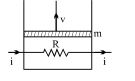
A resistance coil connected to an external battery is placed inside an adiabatic cylinder fitted with a frictionless pistn and containing an ideal gas. A current $i$ flows through the coil which has a resistance $R$. At what speed must the piston move upward in order that the temperature of the gas remains uchanged? Neglect atmospheric pressure. 
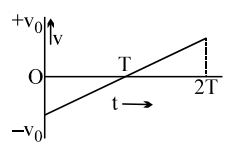
The figure shows the velocity $(v)$ of a particle plotted against time $(t)$
A small particle elastically strikes a fixed smooth sphere of $4\,cm$ radius, with a speed of $5\,m/s$. The impact parameter for the collision is $2\sqrt {3\,} \,cm$ . Calculate the angle of deflection of the particle ............... $^o$
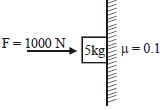
For the given figure, if block remains in equilibrium position then find frictional force between block and wall ........ $N$
The compressibility of water is $4 \times {10^{ - 5}}$ per unit atmospheric pressure. The decrease in volume of $100$ cubic centimeter of water under a pressure of $100$ atmosphere will be ......... $cc$
The escape speed of a projectile on the earth's surface is $11.2\; km s ^{-1} .$ A body is projected out with thrice this speed. What is the speed (in $km/s$) of the body far away from the earth? Ignore the presence of the sun and other planets.
What will be the ratio of the distance moved by a freely falling body from rest in $4^{th}$ and $5^{th}$ seconds of journey ?
Area of liquid film is $6 \times 10\, cm^2$ and surface tension is $T = 20\, dyne/cm$. What is the work done to change area upto $12 \times 10\, cm^2$
Given $a =2 t +5$. Calculate the velocity of the body after five sec if it starts from rest.
Shown below are the black body radiation curves at temperatures $T1$ and $T2$ (T2>T1). Which of the following plots is correct