MCQ
Noble gases are group of elements which exhibit very
- AHigh chemical activity
- ✓Low chemical activity
- CMinimum electronegativity
- DMuch paramagnetic properties
Generate a complete, print-ready paper with questions like this in minutes — across 16+ boards, with answer keys.
$(I)$ $\begin{array}{*{20}{c}} {C{H_3}\,\,\,\,\,\,Br} \\ {|\,\,\,\,\,\,\,\,\,\,\,\,\,\,\,\,|\,\,} \\ {C{H_3} - CH - CH - C{H_3}} \end{array}$
$(II)$ $[Figure\,2]$
$(III)$ $\begin{array}{*{20}{c}} {{C_6}{H_5} - CH - {C_6}{H_5}} \\ {|\,\,\,} \\ {Br} \end{array}$
$(IV)$ $[Figure\,4]$
Which one of the following is correct sequence of the halides given above in the decreasing order of their reactivity ?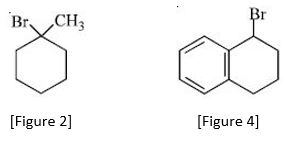
Statement $(I)$ : In the Lanthanoids, the formation of $\mathrm{Ce}^{+4}$ is favoured by its noble gas configuration.
Statement $(II)$ : $\mathrm{Ce}^{+4}$ is a strong oxidant reverting to the common $+3$ state.
In the light of the above statements, choose the most appropriate answer from the options given below:
$CH_3 -C\equiv C-H$ $\xrightarrow{{C{H_3}MgBr}}$ $CH_4+(A)$ $\mathop {\xrightarrow{{(i)\,C{O_2}}}}\limits_{(ii)\,{H_2}O/{H^ \oplus }} $ $(B)$
$(B)$ will be :
$\mathrm{MnO}_2+\mathrm{KOH}+\mathrm{O}_2 \rightarrow \mathrm{A}+\mathrm{H}_2 \mathrm{O} .$
Product ' $A$ ' in neutral or acidic medium disproportionate to give products ' $\mathrm{B}$ ' and ' $\mathrm{C}$ ' along with water. The sum of spin-only magnetic moment values of $B$ and $C$ is . . . . . .$BM$. (nearest integer)
(Given atomic number of $\mathrm{Mn}$ is $25$ )