MCQ
Normal butane convert into isobutane by
  • A
    $LiAl{H_4}$
  • $AlC{l_3}$
  • C
    $NaB{H_4}$
  • D
    $Zn / HCl$

Answer

Correct option: B.
$AlC{l_3}$
b
(b) $\mathop {C{H_3}C{H_2}C{H_2}C{H_3}}\limits_{n - {\rm{butane}}}  \xrightarrow[\Delta]{Anhyd AlCl_3}  \mathop {C{H_3} - \mathop {CH}\limits_{\mathop {|\,\,\,\,\,}\limits_{\,\,C{H_3}} }  - C{H_3}}\limits_{{\rm{iso}}\,{\rm{butane}}} $

Need a full question paper?

Generate a complete, print-ready paper with questions like this in minutes — across 16+ boards, with answer keys.

Start Generating Free

Similar questions

$20\,mL$ of calcium hydroxide was consumed when it was reacted with $10\,mL$ of unknown solution of $H _2 SO _4$. Also $20 mL$ standard solution of $0.5\,M$ $HCl$ containing $2$ drops of phenolphthalein was titrated with calcium hydroxide the mixture showed pink colour when burette displayed the value of $35.5\,mL$ whereas the burette showed $25.5\,mL$ initially. The concentration of $H _2 SO _4$ is $..........M$ (Nearest integer)
The following is (are) endothermic reaction
The most abundant metal among the following is :
The $IUPAC$ name of (figure) is
The total internal energy change for a reversible isothermal cycles is
Equal volume of gases contain equal number of moles.State whether the above statement is true or false.
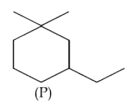
$IUPAC$ name of following compound $(\mathrm{P})$ is 
The solublity of $\mathrm{BaSO}_{4}$ in water $2.42 \times 10^{3}\; \mathrm{gL}^{-1}$ at $298 \;\mathrm{K} .$ The value of solubility product $\left(\mathrm{K}_{\mathrm{sp}}\right)$ will be (Given molar mass of $\mathrm{BaSO}_{4}=233\; \mathrm{g} \;\mathrm{mol}^{-1}$ )
Given below are two statements :

Statement $I$: $\mathrm{S}_8$ solid undergoes disproportionation reaction under alkaline conditions to form $\mathrm{S}^{2-}$ and $\mathrm{S}_2 \mathrm{O}_3{ }^{2-}$

Statement $II$: $\mathrm{ClO}_4^{-}$can undergodisproportionation reaction under acidic condition. In the light of the above statements, choose the most appropriate answer from the options given below :

Which base among the following reacts with diborane to cleave it unsymmetrically ?