Question
$NPN$ transistor are preferred to $PNP$ transistor because they have

Answer

(d) In npn transistors electrons are majority charge carriers and in pnp transistors holes are majority charge carriers. Electrons have high mobility than holes and hence high mobility of energy.

Hence, $n-p-n$ transistors are preferred than $p-n-p$ transistors.

Need a full question paper?

Generate a complete, print-ready paper with questions like this in minutes — across 16+ boards, with answer keys.
Start Generating Free

Similar questions

Particle $A$ is moving along $x$-axis. At time $t=0$, it has velocity of $10\,m / s$ and acceleration $-4\,m / s ^2$. Particle $B$ has velocity of $20\,m / s$ and acceleration $-2\,m / s ^2$. Initially, both the particles are at origin. At time $t=2\,s$, distance between the two particles is $.............\,m$
Which factor does not affect convection?
Two identical capacitors, have the same capacitance $C$. One of them is charged to potential $V_1$ and the other to $V_2$. The negative ends of the capacitors are connected together. When the positive ends are also connected, the decrease in energy of the combined system is
A magnet of magnetic moment $50\,\hat i\,A{\rm{ - }}{m^2}$ is placed along the $x-$ axis in a magnetic field $\overrightarrow B = (0.5\,\hat i + 3.0\hat j)\,T.$ The torque acting on the magnet is
Two waves having the intensities in the ratio of $9 : 1$ produce interference. The ratio of maximum to the minimum intensity, is equal to
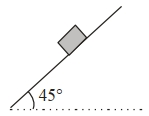
Consider a block kept on an inclined plane (inclined at $45^{\circ}$ ) as shown in the figure. If the force required to just push it up the incline is $2$ times the force required to just prevent it from sliding down, the coefficient of friction between the block and inclined plane $(\mu)$ is equal to
If $x$  and $a$ stand for distance then for what value of $n$ is given equation dimensionally correct the eq. is  $\int {\frac{{dx}}{{\sqrt {{a^2}\, - \,{x^n}} \,}}\, = \,{{\sin }^{ - 1}}\,\frac{x}{a}} $
$A$ tiny air bubble in a glass slab $(\mu = 1.5)$ appears from one side to be $6\, cm$ from the glass surface and from other side, $4\, cm$. The thickness of the glass slab is......$cm$
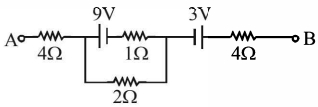
In the circuit shown in figure potential difference between points A and $B$ is $16\,V$. the current passing through $2 \Omega$ resistance will be $...........\,A$
In a compound microscope, if the objective produces an image $I_o$ and the eye piece produces an image $I_e$, then