MCQ
Number of nodal centres for $2s$ orbital
- ✓$1$
- B$0$
- C$4$
- D$3$
Generate a complete, print-ready paper with questions like this in minutes — across 16+ boards, with answer keys.
$Image$
The observed pattern of electrophilic substitution can be explained by
$(A)$ the steric effect of the halogen
$(B)$ the steric effect of the tert-butyl group
$(C)$ the electronic effect of the phenolic group
$(D)$ the electronic effect of the tert-butyl group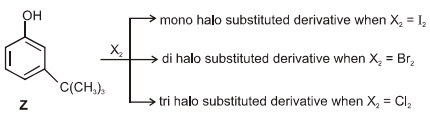
$A.6{H_2}{O_{\left( s \right)}} \rightleftharpoons A.2{H_2}{O_{(s)}} + \mathop {4{H_2}{O_{(g)}}};{{K_P} = 1.6 \times {{10}^{ - 11}}} $
$B.12{H_2}{O_{\left( s \right)}} \rightleftharpoons B.7{H_2}{O_{(s)}} + \mathop {5{H_2}{O_{(g)}}};{{K_P} = 2.43 \times {{10}^{ - 13}}} $
$B.10{H_2}{O_{\left( s \right)}} \rightleftharpoons {C_{(s)}} + \mathop {10{H_2}{O_{(g)}}};{{K_P} = {{10}^{ - 30}}} $
Aqueous tension of $H_2O$ at $0\,^oC$ is given as $0.76\ torr$
$(I)$ The most effective drying agent will be $C_{(s)}$. Out of $C_{(s)}$ , $B. 7H_2O_{(s)}$ & $A. 2H_2O_{(s)}$
$(II)$ At $0\,^oC$, $A.6H_2O_{(s)}$ & $B.12H_2O_{(s)}$ will
$(III)$ If $R.H$ is less than $100\%$ in a chamber at $0\,^oC$, then none of the substance can act as deliquescent
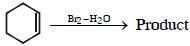
$\Delta_{\text {vap }} \mathrm{H}-\Delta_{\text {vap }} \mathrm{U}=...... \times 10^{2} \,\mathrm{~J}\, \mathrm{~mol}^{-1}$. (Round off to the NearestInteger)
$\left[\right.$ Use : $\left.R=8.31\, \mathrm{~J}\, \mathrm{~mol}^{-1}\, \mathrm{~K}^{-1}\right]$
[Assume volume of $\mathrm{H}_{2} \mathrm{O}(\mathrm{l})$ is much smaller than volume of $\mathrm{H}_{2} \mathrm{O}(\mathrm{g})$. Assume $\mathrm{H}_{2} \mathrm{O}(\mathrm{g})$ treated as an ideal gas]