MCQ
Number of oxygen atoms in a acetamide molecule is
- ✓$1$
- B$2$
- C$3$
- D$4$
Generate a complete, print-ready paper with questions like this in minutes — across 16+ boards, with answer keys.
$\mathop {\begin{array}{*{20}{c}}
{{\mkern 1mu} {\mkern 1mu} Ph}\\
|\\
{C{H_3} - C - OH}\\
|\\
{{\mkern 1mu} {\mkern 1mu} {\mkern 1mu} {\mkern 1mu} {\mkern 1mu} {\mkern 1mu} {\mkern 1mu} {\mkern 1mu} {\mkern 1mu} {\mkern 1mu} {\mkern 1mu} {\mkern 1mu} {\mkern 1mu} {\mkern 1mu} {\mkern 1mu} {\mkern 1mu} {\mkern 1mu} {\mkern 1mu} {\mkern 1mu} {\mkern 1mu} {\mkern 1mu} {\mkern 1mu} {\mkern 1mu} \,\,\,\,\,\,\,\,\,\,\,\,\,\,\,\,\,\,\,\,\,\,C{H_2} - C{H_3}{\mkern 1mu} {\mkern 1mu} }
\end{array}}\limits_{{\rm{'D'}}} $ $\xrightarrow{{HI}}$ products
If the configuration of substrate is $D$, then configuration of products will be
$BF _{3}+ NaH \stackrel{450 K }{\longrightarrow} A + NaF$
$A + NMe _{3} \rightarrow B$
Assertion $A:$ $5 f$ electrons can participate in bonding to a far greater extent than $4 f$ electrons
Reason $R:$ $5 f$ orbitals are not as buried as $4 f$ orbitals
In the light of the above statements, choose the correct answer from the options given below
$\overline{\text { [Given : }}$ Atomic mass of $H =1, C =12, O =16, P =31, Br =80, Ag =108]$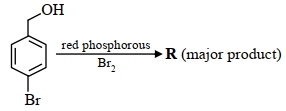
$\mathop {{C_2}{H_5}OH}\limits_{\left( I \right)} $ $\mathop {{C_2}{H_5}Cl}\limits_{\left( {II} \right)} $ $\mathop {{C_2}{H_5}C{H_3}}\limits_{\left( {III} \right)} $ $\mathop {{C_2}{H_5}OC{H_3}}\limits_{\left( {IV} \right)} $