MCQ
Number of primary equations of motion is $............$
  • A
    $1$
  • B
    $2$
  • $3$
  • D
    $4$

Answer

Correct option: C.
$3$
There are primarily $3$ equations of motion.
These are $v = u + at,$
$\text{s}=\text{ut}+\big(\frac{1}{2}\big)\text{at}^2$ and $v^2= u^2 + 2as.$

Need a full question paper?

Generate a complete, print-ready paper with questions like this in minutes — across 16+ boards, with answer keys.
Start Generating Free

Similar questions

A sounding body of negligible dimension emitting a frequency of $150\,\, Hz$ is dropped from a height. During its fall under gravity it passes near a balloon moving up with a constant velocity of $2m/s$ one second after it started to fall.The difference in the frequency observed by the man in balloon just before and just after crossing the body will be : (Given that -velocity of sound $= 300m/s; g = 10m/s^2$)
$\overrightarrow A $ and $\overrightarrow B $ are two vectors given by $\overrightarrow A  = 2\widehat i + 3\widehat j$ and $\overrightarrow B  = \widehat i + \widehat j$. The magnitude of  the component (projection) of $\overrightarrow A$ on $\overrightarrow  B$ is
A body rolls down an inclined plane without slipping. The fraction of total energy associated with its rotation will be:
A stone ties to the end of a string $1\,m$ long is whirled in a horizontal circle with a constant speed. If the stone makes $22$ revolution in $44$ seconds, what is the magnitude and direction of acceleration of the stone
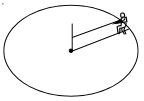
$A$ man is sitting in $a$ smooth groove on a horizontal circular table at the edge by holding a rope joined to the centre. The moment of inertia of table is $I$. Mass of man $= M$. Man now pulls the rope so that he comes to the centre. The angular velocity of the table :
For the four sets of three measured physical quantities as given below. Which of the following options is correct ?

$(i)$ $\mathrm{A}_{1}=24.36, \mathrm{B}_{1}=0.0724, \mathrm{C}_{1}=256.2$

$(ii)$ $\mathrm{A}_{2}=24.44, \mathrm{B}_{2}=16.082, \mathrm{C}_{2}=240.2$

$(iii)$ $\mathrm{A}_{3}=25.2, \mathrm{B}_{3}=19.2812, \mathrm{C}_{3}=236.183$

$(iv)$ $\mathrm{A}_{4}=25, \mathrm{B}_{4}=236.191, \mathrm{C}_{4}=19.5$
The two interfering waves have intensities in the ratio $9 : 4$. The ratio of intensities of maxima and minima in the interference pattern will be
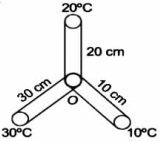
Three rods of same material, same area of crosssection but different lengths $10 \,cm , 20 \,cm$ and $30 \,cm$ are connected at a point as shown. What is temperature of junction $O$ is ......... $^{\circ} C$
If the initial velocity in horizontal direction of a projectile is unit vector $\hat{i}$ and the equation of trajectory is $y =5 x (1- x )$. The $y$ component vector of the initial velocity is.

(Take $g=10\,m / s ^{2}$ )

A body of mass $0.5\; kg$ travels in a stratght line with velocity $v=a x^{3 / 2}$ where $a=5\; m ^{-1 / 2} s ^{-1}$ What is the work done (in $J$) by the net force during its displacement from $x=0$ to $x=2\; m ?$