MCQ
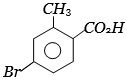
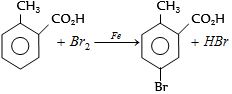
$o-$ Toluic acid on reaction with $B{r_2} + Fe$ gives
  • A

  • B


  • D

Answer

Correct option: C.

c
(c) $ - \,COOH$ is meta directing group
 

Need a full question paper?

Generate a complete, print-ready paper with questions like this in minutes — across 16+ boards, with answer keys.

Start Generating Free

Similar questions

Which will have minimum osmotic pressure ?
Among $(a) - (d)$ the complexes that can display geometrical isomerism are

$(a)$ $\left[\mathrm{Pt}\left(\mathrm{NH}_{3}\right)_{3} \mathrm{Cl}\right]^{+}$

$(b)$ $\left[\mathrm{Pt}\left(\mathrm{NH}_{3}\right) \mathrm{Cl}_{5}\right]^{-}$

$(c)$ $\left[\mathrm{Pt}\left(\mathrm{NH}_{3}\right)_{2} \mathrm{Cl}\left(\mathrm{NO}_{2}\right)\right]$

$(d)$ $\left[\mathrm{Pt}\left(\mathrm{NH}_{3}\right)_{4} \mathrm{ClBr}\right]^{2+}$

 Compounds A and C in the following reaction are __________.

$\text{CH}_3\text{CHO}\xrightarrow[(\text{ii})\ \text{H}_2\text{O}]{(\text{i})\text{CH}_3\text{MgBr}}\text{A}\xrightarrow{\text{H}_2\text{SO}_4.\triangle}\text{(B)}\xrightarrow{\text{Hydroboration oxidation}}\text{(C)}$

Which does not give isocyanide test ?
On introducing a catalyst at $500\,K,$ the rate constant of a first order reaction increases $2.718$ times. If the activation energy in the presence of a catalyst is $4.15\, kJ\, mol^{-1}.$ Then what will be $E_a$ in absence of catalyst (value of $e = 2.718$ ) ......... $kJ$
Match the compounds given in $column\, I$ with the hybridisation and shape given in $column\, II$ and mark the correct option.

 $\begin{array}{|l|l|} \hline Column\,\,I & Column\,\,II \\ \hline (A)\,XeF_6 & (i)\,\,distortedoctahedral \\ \hline (B)\,XeO_3 & (ii)\,\,square\,\,planar \\ \hline (C)\,XeOF_4 & (iii)\,\,pyramidal \\ \hline (D)\,XeF_4 & (iv)\,\,square\,\,pyramidal \\ \hline \end{array}$

Which of the following acids forms three series of salts ?
An organic compound '$A$' contains nitrogen and chlorine. It dissolves readily in water to give a solution that turns litmus red. Titration of compound '$A$' with standard base indicates that the molecular weight of ' $A$ ' is $131\,\pm\,2$. When a sample of '$A$' is treated with aq. $NaOH$, a liquid separates which contains $N$ but not $Cl$. Treatment of the obtained liquid with nitrous acid followed by phenol gives orange precipitate. The compound '$A$' is.
The osmotic pressure of equimolar solutions of urea, $BaCl_2$ and $AlCl_3$ will be in the order
$D-$ Glucose and $L-$ Glucose are