MCQ
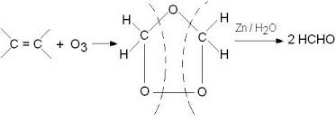
${O_3}$ reacts with $C{H_2} = C{H_2}$ to form ozonide. On hydrolysis it forms
  • A
    Ethylene oxide
  • $HCHO$
  • C
    Ethylene glycol
  • D
    Ethyl alcohol

Answer

Correct option: B.
$HCHO$
b
hydrolysis of ozonide  gives formaldehyde.

Need a full question paper?

Generate a complete, print-ready paper with questions like this in minutes — across 16+ boards, with answer keys.
Start Generating Free

Similar questions

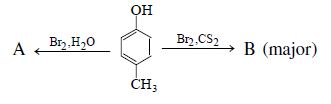
(major) '$A$' and '$B$' are respectively
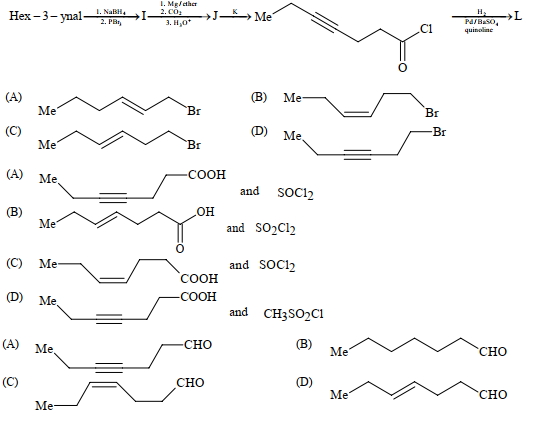
In the following sequence, products $\mathrm{I}, \mathrm{J}$ and $\mathrm{L}$ are formed. $\mathrm{K}$ represents a reagent.

$Image$

$1.$ The structure of the product $\mathrm{I}$ is

A,B,C,D,  $Image$

$2.$ The structures of compounds $J$ and $K$ respectively are

A,B,C,D,  $Image$

$3.$ The structure of product $L$ is

A,B,C,D,  $Image$

Give the answer question $1,2$ and $3.$
The light yellow compound produced when acetone reacts with iodine and alkali, is
In presence of $AlC{l_3},$ benzene and  $ n-$ propyl bromide react in Friedal-Craft's reaction to form
Increasing order of nucleophilicity of $I ^{-}, Cl ^{-}$and $Br ^{-}$:
A graph plotted between $\log \,K$ vs $ 1/T$ for calculating activation energy is shown by
The slope of the line in the plot of concentration [A] Vs. time (s) indicate
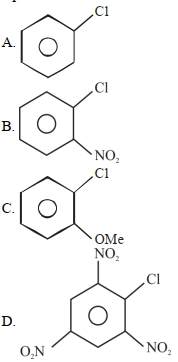
The correct order of reactivity of following haloarenes towards nucleophilic substitution with aqueous $NaoH$ is:

Choose the correct answer from the options given below:
Which of the following options are correct?
$a.$ Micelle formation by soap in aqueous solution is possible at all temperatures.
$b.$ Micelle formation by soap in aqueous solution occurs above a particular concentration.
$c.$ On dilution of soap solution micelles may revert to individual ions.
$d.$ Soap solution behaves as a normal strong electrolyte at all concentrations.
In the given pair of alcohol, in which pair second alcohol is more reactive than first  towards hydrogen bromide?