Question
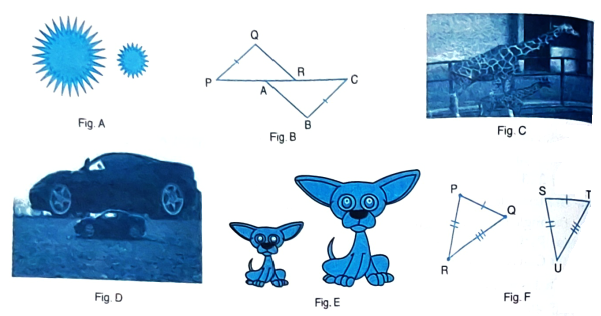
Observe the below given figures carefully and answer the questions:
Image
(i) Which among the above shown figures are congruent figures?
(a) A and C $\qquad$ (b) $E$ and $F$ $\qquad$ (c) $D$ and $F$ $\qquad$ (d) $B$ and $F$
(ii) Which of the following statements is correct?
(a) All similar figures are congruent.
(b) All congruent figures are similar.
(c) The criterion for similarity and congruency is same.
(d) Similar figures have same size and shape.
(iii) If a line divides any two sides of the triangle in the same ratio, then the line is parallel to the third side. Which theorem is depicted by this statement?
(a) Pythagoras
(b) Thales Theorem
(c) Converse of Thales theorem
(d) Converse of Pythagoras theorem
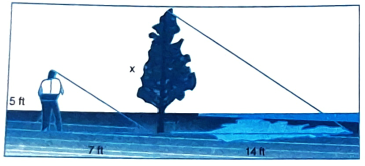
(iv) Using the concept of similarity, the height of the tree is
Image
(a) 12 ft $\qquad$ (b) 10 ft $\qquad$ (c) 15 ft $\qquad$ (d) 7 ft

Answer

(i) (d) (ii) (b) (iii) (c) (iv) (b)

Need a full question paper?

Generate a complete, print-ready paper with questions like this in minutes — across 16+ boards, with answer keys.

Start Generating Free

Similar questions

Raman usually go to a dry fruit shop with his mother. He observes the following two situations.
On 1st day: The cost of 2 kg of almonds and 1 kg of cashew was ₹1600.
On 2nd day: The cost of 4 kg of almonds and 2 kg of cashew was ₹3000.
Denoting the cost of 1 kg almonds by x and cost of 1 kg cashew by y, answer the following questions
  1. Linear equations represented by day-I and day -II situations, are
  2. Represent algebraically the situation of day-II.
  3. The linear equation represented by day-1, intersect the x axis at
    Or
    The linear equation represented by day-II, intersect the y-axis at

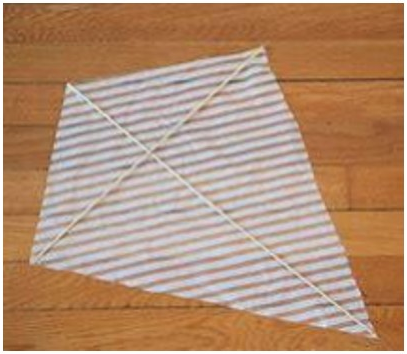
Rahul is studying in X Standard. He is making a kite to fly it on a Sunday. Few questions came to his mind while making the kite. Give answers to his questions by looking at the figure.
  1. In a triangle, if the square of one side is equal to the sum of the squares of the other two sides, then the angle opposite the first side is a right angle. This theorem is called.
  2. Which is the correct similarity criteria applicable for smaller triangles at the upper part of this kite?
  3. Sides of two similar triangles are in the ratio 4:9. Corresponding medians of these triangles are in the ratio:
    OR
    What is the area of the kite, formed by two perpendicular sticks of length 6cm and 8cm?
Ms. Sheela visited a store near her house and found that the glass jars are arranged one above the other in a specific pattern.
On the top layer there are $3$ jars. In the next layer there are $6$ jars. In the $3^{rd}$ layer from
the top there are $9$ jars and so on till the $8^{th}$ layer.
On the basis of the above situation answer the following questions.
$(i)$ Write an $A.P$ whose terms represent the number of jars in different layers starting
from top . Also, find the common difference.
$(ii)$ Is it possible to arrange $34$ jars in a layer if this pattern is continued? Justify your
answer.
$(iii) (A)$ If there are $' n\ '$ number of rows in a layer then find the expression for finding the total number of jars in terms of $n$.
Hence find $S_8$.
OR
$(iii) (B)$ The shopkeeper added $3$ jars in each layer. How many jars are there in the $5^{th}$ layer from the top?

As we know a tree or a plant needs both soil and water along with sunlight to
grow. It will have the necessary nourishment in both water and sun to make its
leaves green and fruit to grow. A rural Indian school Gardner planted some
trees on his school at certain distances from the water body following a sequence.
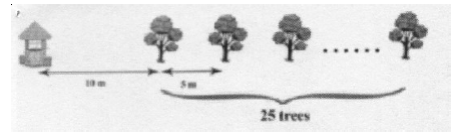
There are 25 trees at equal distances of 5 meters in a line with a well, the
distance of the well from the nearest tree being 10 meters. A gardener waters
all the trees separately starting from the well and he returns to the well after
watering each tree to get water for the next.

(i) Distance travelled to water nearest tree and back to the well is:
(ii) Progression so formed in the above condition is
(iii) Distance travelled to water 25th tree.
OR
The total distance the gardener will cover in order to water all the trees.
A seminar is being conducted by an educational organisation, where the participants will be educators of different subjects. The numbers of participants in Hindi, English and Mathematics are 60, 84 and 108 respectively.
(i) In each room the same number of participants are to be seated and all of them being in the same subject, hence the maximum number of participants that can be accomodated in each room is
(a) 14 $\qquad$ (b) 12$\qquad$ (c) 16 $\qquad$ (d) 18
(ii) The minimum number of rooms required during the event, is
(a) 11 $\qquad$ (b) 9 $\qquad$ (c) 7 $\qquad$ (d) 21
(iii) The LCM of 60,84 and 108 is
(a) 3780 $\qquad$ (b) 3680 $\qquad$ (c) 4780 $\qquad$ (d) 4680
(iv) The product of HCF and LCM of 60,84 and 108 is
(a) 55360 $\qquad$ (b) 35360 $\qquad$ (c) 45500 $\qquad$ (d) 45360
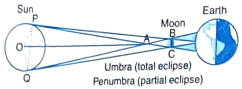
A solar eclipse occurs when the Moon passed between the Earth and the Sun. Following diagram represents the total and partial eclipse.
Image
(i) The tangents to the Moon surface from the point $A$ are
(a) $A B$ and $A C$ $\qquad$ (b) $A P$ and $A Q$
(c) $A P$ and $A B$ $\qquad$ (d) $A Q$ and $A C$
(ii) If $\angle P A Q=40^{\circ}$, then the measure of $\angle P O Q$ is
(a) $70^{\circ}$ $\qquad$ (b) $40^{\circ}$ $\qquad$ (c) $50^{\circ}$ $\qquad$ (d) $140^{\circ}$
(iii) If $\angle P O Q=110^{\circ}$, then $\angle Q A O=$
(a) $55^{\circ}$ $\qquad$ (b) $35^{\circ}$ $\qquad$ (c) $70^{\circ}$ $\qquad$ (d) $110^{\circ}$
(iv) If $\angle P O Q=130^{\circ}$, then $\angle O P Q=$
(a) $130^{\circ}$ $\qquad$ (b) $50^{\circ}$ $\qquad$ (c) $65^{\circ}$ $\qquad$ (d) $25^{\circ}$

Applications of Parabolas
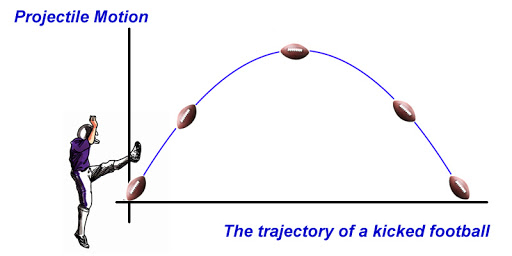
Parabola has many applications in our day-to-day life. For example, if an object (projectile) is thrown in space, then the path of the projectile is a parabola. If we know the equation of the path of a projectile by using various properties of parabola, we can obtain may important results like greatest height attained by the projectile, its horizontal range reached etc.
Parabola: A parabola is the graph that results from $p(x) = ax^2 + bx + c$ they are symmetric about a vertical line known as the axis of symmetry and runs through the maximum or minimum point of the parabola which is called the vertex.

Graph of a quadratic polynomial is:
The number of zeroes that polynomial $p(x)=(x-2)^2+5$ can have is:
If a parabolic trajectory is represented by $x^2-4 x+3$, then its zeroes are:
Or
If one zero of a parabolic trajectory $p(y)=5 y^2-14 y+k$ is reciprocal of the other, the find the value of $k$ :