Question
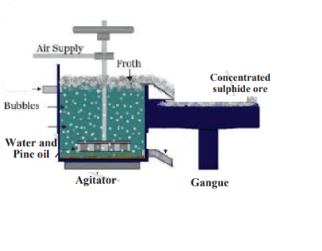
Observe the figure and name and explain in brief the following method:Image

Answer

The method shown in the figure is froth floatation method.
  1. The froth floatation process is based on two opposite properties of the particles, hydrophilic and hydrophobic.
  2. The metal sulphide particles are hydrophobic. Due to this property, they get wetted mainly with oil. On the other hand, gangue particles are hydrophilic and get wetted by water.
  3. In this method, the finely divided metal ore is added in a big tank containing a large amount of water. To this, certain vegetable oil (pine oil, eucalyptus oil, etc.) is added is added for the formation of froth. A rotating agitator at the centre of the floatation tank agitates the mixture and draws air into it to form bubbles. As a result, foam is formed which carries metal sulphide particles. The foam rises to the surface of water and floats. Therefore, this method is called the froth floatation process.
  4. This method is used to separate metal sulphide ores such as zinc blende $(ZnS)$ and copper pyrite $(CuFeS_2).$

Need a full question paper?

Generate a complete, print-ready paper with questions like this in minutes — across 16+ boards, with answer keys.

Start Generating Free

Similar questions

Write all the capital letters of the alphabet which look the same in a plane mirror.
Which is the energy currency of the cell? Explain.
A man with blood group $A$ marries a woman with blood group $O$ and their daughter has blood group $O$. Is this information enough to tell you which of the traits-blood group A or $O$ - is dominant? Why or why not?
what is the periodic trend in the variation of valency while going from left to right within a period? Explain your answer with reference to period 2 and period 3.
What is meant by the apparent size of an object? With a neat and labelled diagram, explain the relation between the apparent size of an object and the angle subtended by the object at the eye.
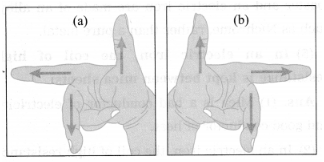
Name the following diagrams and explain the concept behind them.Image
1. Fleming’s right hand rule:
2. Fleming’s left hand rule:
(translation, anticodon, tRNA, mRNA, amino acids, triplet codon, transcription, DNA)
The …….. formed in nucleus comes in cytoplasm. It brings in the coded message from DNA. The message contains the codes for amino acids. The code for each amino acid consists of three nucleotides. It is called as ‘………..’. Each mRNA is made up of thousands of triplet codons. As per the message on mRNA, ……… are supplied by the ………. For this purpose, tRNA has ‘…………’ having complementary sequence to the codon on mRNA. This is called ‘………..’.
A certain form of energy is available due to the difference in the temperature of water at the surface of the ocean and its deeper levels.
  1. Name the form of energy.
  2. Is this energy ultimately derived from the sun or not?
  3. Explain how this form of energy can be converted into electricity.
  4. What is the minimum temperature difference in water at the surface of ocean and its deeper level which is required to operate power plants based on this energy?
Draw the labelled diagram of an $A.C$. generator. With the help of this diagram, explain the construction and working of an $A.C.$ generator.
State five uses of metals and five of non-metals.