Question
Obtain an expression for the capacitance of a parallel plate capacitor without a dielectric.

Answer

i. A parallel plate capacitor consists of two thin conducting plates each of area A, held parallel to each other, at a suitable distance $d$ apart.
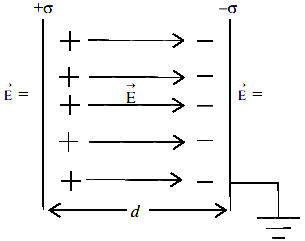
ii. The plates are separated by an insulating medium like paper, air, mica, glass, etc. One of the plates is insulated and the other is earthed as shown in the figure below.

iii. When a charge $+Q$ is given to the insulated plate, then a charge $-Q$ is induced on the inner face of the earthed plate and $+Q$ is induced on its farther face. But as this face is earthed the charge $+Q$ being free, flows to earth.
iv. In the outer regions, the electric fields due to the two charged plates cancel out. Making net field is zero.
$
E =\frac{\sigma}{2 \varepsilon_0}-\frac{\sigma}{2 \varepsilon_0}=0
$
$v$. In the inner regions between the two capacitor plates, the electric fields due to the two charged plates add up. The net field is thus
$
E =\frac{\sigma}{2 \varepsilon_0}+\frac{\sigma}{2 \varepsilon_0}=\frac{\sigma}{\varepsilon_0}=\frac{ Q }{ A \varepsilon_0} \ldots . . \text { (1) }
$
The direction of $E$ is from positive to negative plate.
vi. Let $V$ be the potential difference between the two plates. Then electric field between the plates is given by $E=\frac{V}{d}$ or $V= Ed$....(2)
Substituting equation (1) in equation (2),
$
V=\frac{Q}{A \varepsilon_0} d
$
vii. Thus, the capacitance of the parallel plate capacitor is given by,
$
C =\frac{ Q }{ V }=\frac{ Q }{\left(\frac{ Qd }{ A \varepsilon_0}\right)}=\frac{ A \varepsilon_0}{ d }
$
This is the required expression.

Need a full question paper?

Generate a complete, print-ready paper with questions like this in minutes — across 16+ boards, with answer keys.
Start Generating Free

Similar questions

In Young's double-slit experiment, the second minimum in the interference pattern is exactly in front of one slit. The distance between the two slits is $d$ and that between the source and screen is $D$. What is the wavelength of the light used?
Explain the construction of plane wavefront using Huygens' principle
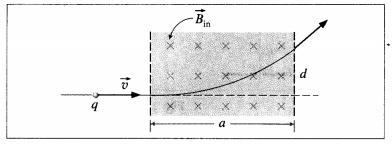
A particle of charge $q$ enters a region of uniform magnetic field $\vec{B}$ (pointing into the page). The field deflects the particle a distance $d$ above the original line of flight, as shown in below figure. Is the charge positive or negative? Find the momentum of the particle in terms of $a_{\text {, }}$ $d , B$ and $q$.
Image
Distinguish between free vibrations and forced vibrations.
A raindrop of diameter $4 \mathrm{~mm}$ is about to fall on the ground. Calculate the pressure inside the rain drop. [Surface tension of water $\mathrm{T}=0.072 \mathrm{~N} / \mathrm{m}$, atmospheric pressure $=1.013 \times 10^5$ $\mathrm{N} / \mathrm{m}^2$ )
State the function of the shunt in modifying a galvonometer to an ammeter.
A coil has $300$ turns, each of area $0.05 m^2. (i)$ Find the current through the coil for which the magnetic moment of the coil will be $4.5 A - m^2. (ii)$ It is placed in a uniform magnetic field of induction $0.2 T$ with its magnetic moment making an angle of $30^{\circ}$ with $\vec{B}$. Calculate the magnitude of the torque experienced by the coil. $( 3$ marks$)$
A toroid of circular cross section of radius $0.05 m$ has $2000$ windings and a self inductance of $0.04 H$. What is $(a)$ the current through the windings when the energy in its magnetic field is $2 \times 10^{-6} J ( b )$ the central radius of the toroid?
The mean free path of a gas molecule is $60 \mathrm{~nm}$ when the density of the gas is $1.2 \mathrm{~kg} / \mathrm{m}^3$. What will be the mean free path if the density is reduced to $0.8 \mathrm{~kg} / \mathrm{m}^3$ ?
Explain Maxwell distribution of molecular speed with necessary graph.