Maharashtra BoardEnglish MediumSTD 12 SciencePhysicsQuestion Bank [ 2022 ]3 Marks
Question
Obtain an expression for the capillary rise or fall using the forces method.
✓
Answer
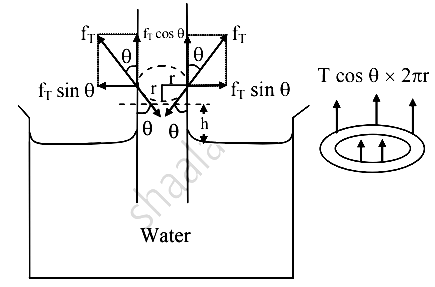
i. When a glass capillary tube is dipped into a liquid, then the liquid rises in the capillary against gravity. Hence, the weight of the liquid column must be equal and opposite to the component of force due to surface tension at the point of contact. ii. The length of liquid in contact inside the capillary is the circumference $2 \pi r$. Let, $r=$ radius of the capillary tube $h=$ height of liquid level in the tube $T =$ surface tension of the liquid $r=$ density of liquid $g =$ acceleration due to gravity iii. The force of magnitude $f _{ T }$ acts tangentially on a unit length of liquid surface which is in contact with the wall of the capillary tube and is given as $f_T=T \times 2 \pi r$ This force can be resolved into two components: a. $f _{ T } \cos \theta$-vertically upward and b. $f _{ T } \sin \theta$-along horizontal iv. The vertical component is effective. The horizontal component is not responsible for the capillary rise. $v$. The vertical component of force acting on the liquid column $\left( f _{ T }\right)_{ V }=$ force per unit length $\times$ circumference $= T \cos \theta \times 2 \pi r$ vi. Upward force balances the weight of the liquid in the capillary. $W = mg = Vrg =\pi r ^2 h \rho g$ where $V =$ volume of liquid rise in the tube (ignoring the liquid in the concave meniscus.) $m$ = mass of the liquid in the capillary rise. This must be equal and opposite to the vertical component of the force due to surface tension. vii. If the liquid in the meniscus is neglected, then for equilibrium., $2 \pi r T \cos \theta=\pi r^2 h \rho g$ $ \therefore h =\frac{2 T \cos \theta}{r \rho g} $ viii. This is the required expression for the rising or fall of liquid in a capil Rise of liquid in a capillary tube
Need a full question paper?
Generate a complete, print-ready paper with questions like this in minutes — across 16+ boards, with answer keys.