Question
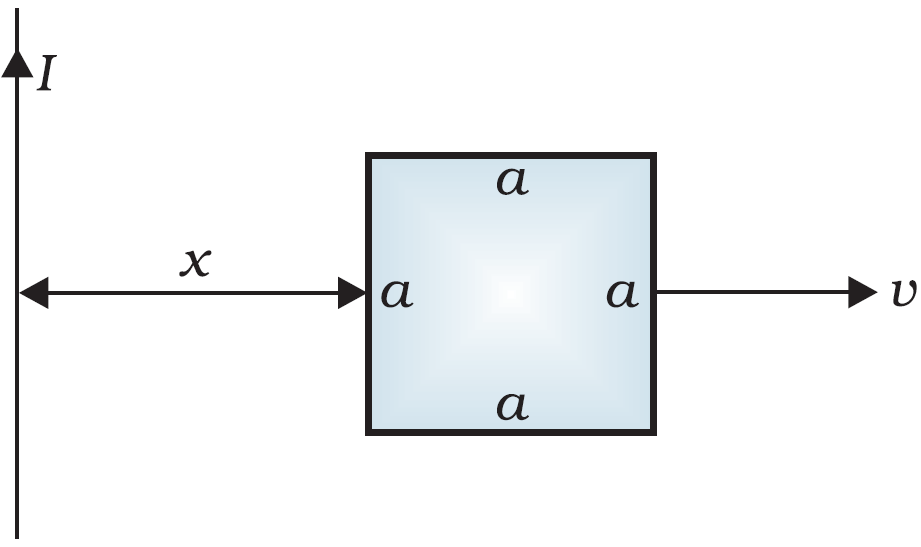
  1. Obtain an expression for the mutual inductance between a long straight wire and a square loop of side a as shown in Fig.
  2. Now assume that the straight wire carries a current of $50A$ and the loop is moved to the right with a constant velocity $, v = 10\ m/s.$ Calculate the induced emf in the loop at the instant when $x = 0.2\ m$. Take $a = 0.1\ m$ and assume that the loop has a large resistance.
Answer

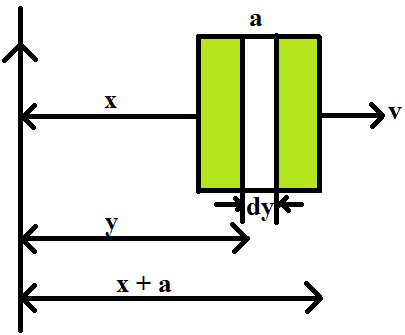
  1. Take a small element dy in the loop at a distance $y$ from the long straight wire $ ($as shown in the given figure$)$.
  2. Magnetic flux associated with element dy, $\text{d}\phi=\text{BdA}$
    Where,
    $dA =$ Area of element $dy = \text{ady}$
    $B =$ Magnetic field at distance $y$
    $=\frac{\mu_0\text{I}}{2\pi\text{y}}\text{s}$
    $I = $ Current in the wire
    $\mu_0=\text{Permeability of free space}=4\pi\times10^{-7}\text{Tm}\text{A}^{-1}$
    $\therefore\ \text{d}\phi=\frac{\mu_0\text{Ia}}{2\pi}\frac{\text{dy}}{\text{y}}\text{s}$
    $\phi=\frac{\mu_0\text{Ia}}{2\pi}\int\frac{\text{dy}}{\text{y}}$
    $y$ tends from $x$ to $a + x.s$
    $\therefore\ \phi=\frac{\mu_0\text{I}\text{a}^{\text{a}+\text{x}}}{2\pi}\int_{\text{x}}\frac{\text{dy}}{\text{y}}$
    $=\frac{\mu_0\text{Ia}}{2\pi}\big[\log_{\text{e}}\text{ y}\big]_{\text{x}}^{\text{a}+\text{x}}$
    $=\frac{\mu_0\text{Ia}}{2\pi}\log_{\text{e}}\Big(\frac{\text{a}+\text{x}}{\text{x}}\Big)$
    For mutual inductance $M,$ the flux is given as:
    $\phi=\text{mI}$
    $\therefore\ \text{mI}=\frac{\mu_0\text{Ia}}{2\pi}\log_{\text{e}}\Big(\frac{\text{a}}{\text{x}}+1\Big)$
    $\text{m}=\frac{\mu_0\text{a}}{2\pi}\log_{\text{e}}\Big(\frac{\text{a}}{\text{x}}+1\Big)$
  3. Emf induced in the loop, $\text{e}=\text{B}'\text{av}\Big(\frac{\mu_0}{2\pi}\Big)\text{av}$ Given,
  4. $I = 50A$
    $x = 0.2m$
    $a = 0.1m$
    $v = 10m/s$
    $\text{BQv}=\frac{\text{M}\text{v}^2}{\text{r}}$
    $\therefore\ \text{B}2\pi\text{r}\lambda\text{r}^2=\frac{\text{Mv}}{\text{r}}$
    $\text{v}=\frac{\text{B}2\pi\text{r}\lambda\text{r}^2}{\text{M}}$
    For $\text{r}\leq\text{a}$ and $\text{a}<\text{R},$ we get
    $(\text{i})=-\frac{2\text{B}_0\text{a}^2\lambda}{\text{MR}}\text{k}$
  5. $e = 5 \times 10^{-5}V$

Need a full question paper?

Generate a complete, print-ready paper with questions like this in minutes — across 16+ boards, with answer keys.

Start Generating Free

Similar questions

Potassium$-40$ can decay in three modes. It can decay by $\beta^-$-emission, $\beta^+$-emission of electron capture.
  1. Write the equations showing the end products.
  2. Find the $Q-$values in each of the three cases. Atomic masses of $\text{ }^{40}_{18}\text{Ar},\text{ }^{40}_{19}\text{K}$ and $\text{ }^{40}_{20}\text{Ca}$ are $39.9624u,39.9640u$ and $39.9626u$ respectively.

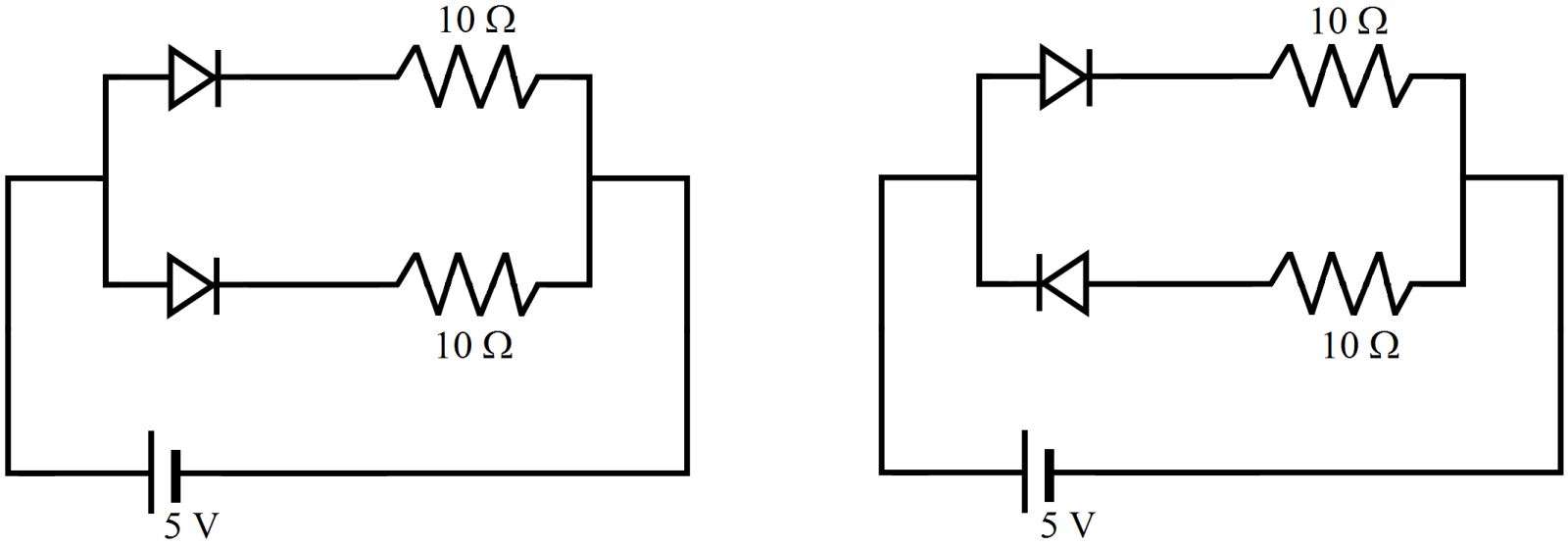
Find the current through the battery circuits shown in figure.
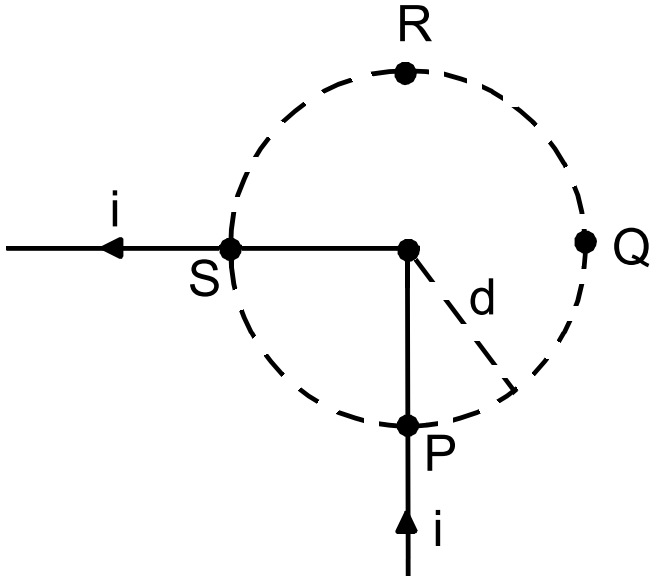
Figure shows a long wire bent at the middle to form a right angle. Show that the magnitudes of the magnetic fields at the points $P, Q, R$ and $S$ are equal and find this magnitude.
A current of $1.0A$ exists in a copper wire of cross$-$section $1.0mm^2$. Assuming one free electron per atom, calculate the drift speed of the free electrons in the wire. The density of copper is $9000\ kg/m^{-3}.$
$^{238}U$ decays to $^{206}Pb$ with a half$-$life of $4.47 \times 10^9y$. This happens in a number of steps. Can you justify a single half for this chain of processes? A sample of rock is found to contain $2.00\ mg$ of $^{238}U$ and $0.600\ mg$ of $^{206}Pb$. Assuming that all the lead has come from uranium, find the life of the rock.
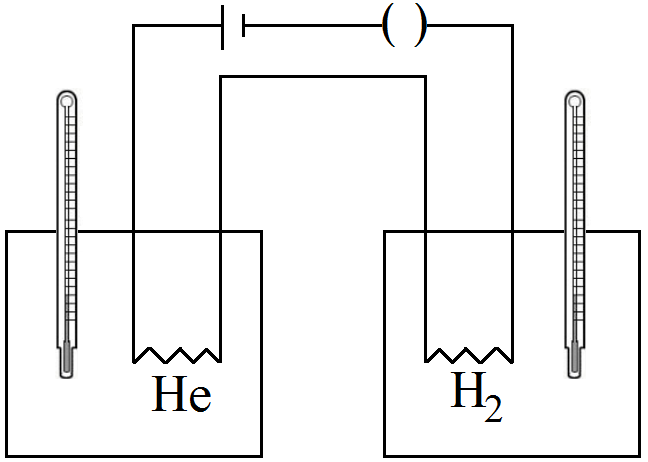
The figure shows two vessels with adiabatic walls, one containing $0.1g$ of helium $\big(\gamma=1.67,\text{M}=4\text{g-mol}^{-1}\big)$ and the other containing some amount of hydrogen $\big(\gamma=1.4,\text{M}=2\text{g-mol}^{-1}\big).$ Initially, the temperatures of the two gases are equal. The gases are electrically heated for some time during which equal amounts of heat are given to the two gases. It is found that the temperatures rise through the same amount in the two vessels. Calculate the mass of hydrogen.
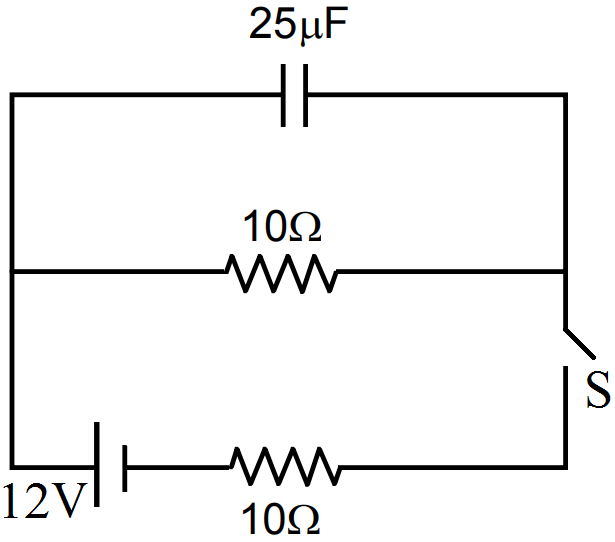
The switch S shown in figure. is kept closed for a long time and is then opened at t = 0. Find the current in the middle $1.0\Omega$ resistor at t = 1ms.
The elevator shown in figure is descending with an acceleration of $2\ m/s^2.$ The mass of the block $A$ is $0.5\ kg$. What force is exerted by the block $A$ on the block $B?$​​​​​​​
Calculate the Q-values of the following fusion reactions:
  1. $\text{ }^2_1\text{H}+\text{ }^2_1\text{H}\rightarrow\text{ }^3_1\text{H}+\text{ }^1_1\text{H}$
  2. $\text{ }^2_1\text{H}+\text{ }^2_1\text{H}\rightarrow\text{ }^3_2\text{H}+\text{n}$
  3. $\text{ }^2_1\text{H}+\text{ }^3_1\text{H}\rightarrow\text{ }^4_1\text{H}+\text{n}$
Atomic masses are
$\text{m}\big(\text{ }^2_1\text{H}\big)=2.014102\text{u}$
$\text{m}\big(\text{ }^3_1\text{H}\big)=3·016049\text{u}$
$\text{m}\big(\text{ }^3_2\text{H}\big)=3.016029\text{u}$
$\text{m}\big(\text{ }^4_2\text{He}\big)=4·002603\text{u}$
Figure shows two parallel wires separated by a distance of $4.0\ cm$ and carrying equal currents of $10A$ along opposite directions. Find the magnitude of the magnetic field $B$ at the points $A_1, A_2, A_3$ and $A_4.$​​​​​​​