Question
Obtain Faraday's law of induction explaining Faraday's experiments regarding electric induction with reference to magnetic flux.

Answer

From experimental observations of experiments of Faraday and Henry, it is clear that initially magnetic flux gets linked with coil, after that linked magnetic flux changes and then induced current or induced emf arises.
•Experiment 1 :
In experiment of coil and magnet, magnetic flux is linked with coil due to magnet.
On giving relative motion between them, linked magnetic flux changes and induced current arises.
• Experiment 2 :
In experiment of two coils, on passing electric current through any one coil, magnetic field is produced. Due to this, magnetic flux is linked with other coil.
On giving relative motion between two coils, linked magnetic flux changes and induced current is produced.
• Experiment 3 :
In experiment of two stationary coils, making key on-off, produces magnetic field and hence magnetic flux linked with other coil changes and thus galvanometer shows deflection.
Keeping key in closed situation, linked magnetic flux does not change and galvanometer shows zero deflection.
Thus, clear conclusion from all these experiments is that linking magnetic flux with coil by any means, changing linked magnetic flux with time, induced emf is produced.
• Faraday's law of electromagnetic induction :
→The magnitude of induced emf in a circuit is equal to the time rate of change of magnetic flux through the circuit.
Induced emf is shown mathematically as below :
$\varepsilon=-\frac{d \phi_{ B }}{d t}$
The negative sign in the equation indicates the direction of $\varepsilon$ and hence the direction of current in the closed circuit (loop). (It can also be said that it shows presence of Lenz's law.)
If number of turns in coil is N then
$\varepsilon=- N \frac{d \phi_{ B }}{d t}$

Need a full question paper?

Generate a complete, print-ready paper with questions like this in minutes — across 16+ boards, with answer keys.
Start Generating Free

Similar questions

Calculate the mass of an $\alpha$-particle. Its binding energy is 28.2MeV.
Explain J J. Thomson's plum pudding model of atom.
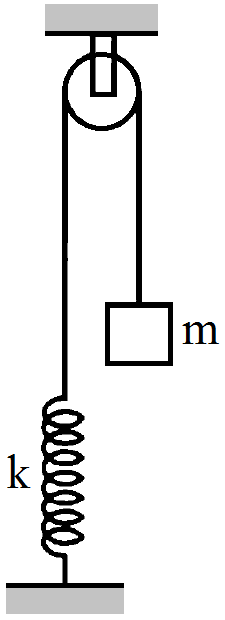
Consider the situation shown in figure. Initially the spring is unstretched when the system is released from rest. Assuming no friction in the pulley, find the maximum elongation of the spring.
A hydrogen atom in a state having a binding energy of 0.85eV makes transition to a state with excitation energy 10.2eV (a) Identify the quantum numbers n of the upper and the lower energy states involved in the transition. (b) Find the wavelength of the emitted radiation.
A proton and an alpha particle having the same kinetic energy are, in turn, passed through a region of the uniform magnetic field, acting normal to the plane of the paper and travel in circular paths. Deduce the ratio of the radii of the circular paths described by them.
Answer the following question:
The angle subtended at the eye by an object is equal to the angle subtended at the eye by the virtual image produced by a magnifying glass. In what sense then does a magnifying glass provide angular magnification?
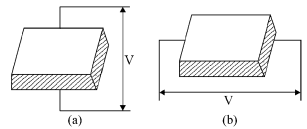
In a given figure, a rectangular object is shown. Its length is I, breadth is 0.5 I and thickness 0.25 I . To measure its resistance, potential difference $V$ is applied in two ways [figure (a) and (b)]. In which arrangement, the resistance of the substance will be more?
Image
A cylinder rolls on a horizontal plane surface. If the speed of the centre is 25m/s, what is the speed of the highest point?
A projectile is fired from the top of a 40m high cliff with an initial speed of 50m/s at an unknown angle. Find its speed when it hits the ground.
A magnetic needle free to rotate in a vertical plane parallel to the magnetic meridian has its north tip down at 60° with the horizontal. The horizontal component of the earth's magnetic field at the place is known to be 0.4 G. Determine the magnitude of the earth's magnetic field at the place.