Question
Obtain the angular magnification for the image formed at infinity for simple microscope.
Answer

Image
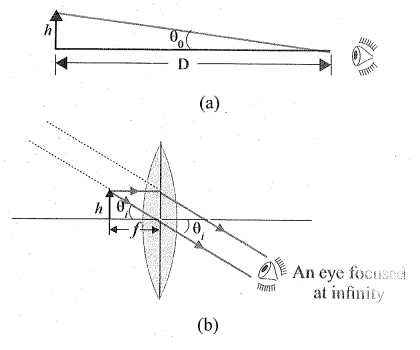
→When an object of height $h$ is placed at the near point as shown in the figure (a), the angle subtended at the eye by the object is $\theta_0$.
→from figure, $\tan \theta_0=\frac{h}{ D }$
for small angle, $\tan \theta_0 \approx \theta_0=\frac{h}{ D }......(1)$
→As shown in figure (b), if an object of height $h$ is placed at the principal focus, its image will be at an infinite distance. This time, the angle subtended at the eye by the object is $\theta_i$.
→from figure, $\tan \theta_i=\frac{h}{f}$
but for small angle, $\tan \theta_i \approx \theta_i=\frac{h}{f}......(2)$
→angular magnification of lens,
$\begin{aligned}m & =\frac{\theta_i}{\theta_0}=\frac{\frac{h}{f}}{\frac{h}{ D }}=\frac{h}{f} \times \frac{ D }{h} \\\therefore m & =\frac{ D }{f}\end{aligned}$
→This is the magnification when the image is at infinity.
→Thus, the magnification obtained with simple microscope is between $\frac{ D }{f}$ to $1+\frac{ D }{f}$.

Need a full question paper?

Generate a complete, print-ready paper with questions like this in minutes — across 16+ boards, with answer keys.
Start Generating Free

Similar questions

Double-convex lenses are to be manufactured from a glass of refractive index 1.55, with both faces of the same radius of curvature. What is the radius of curvature required if the focal length to be 20 cm?
Consider an ice cube of edge 1.0cm kept in a gravity free hall. Find the surface area of the water when the ice melts. Neglect the difference in densities of ice and water.
Distinguish between 'intrinsic' and 'extrinsic' semiconductors.
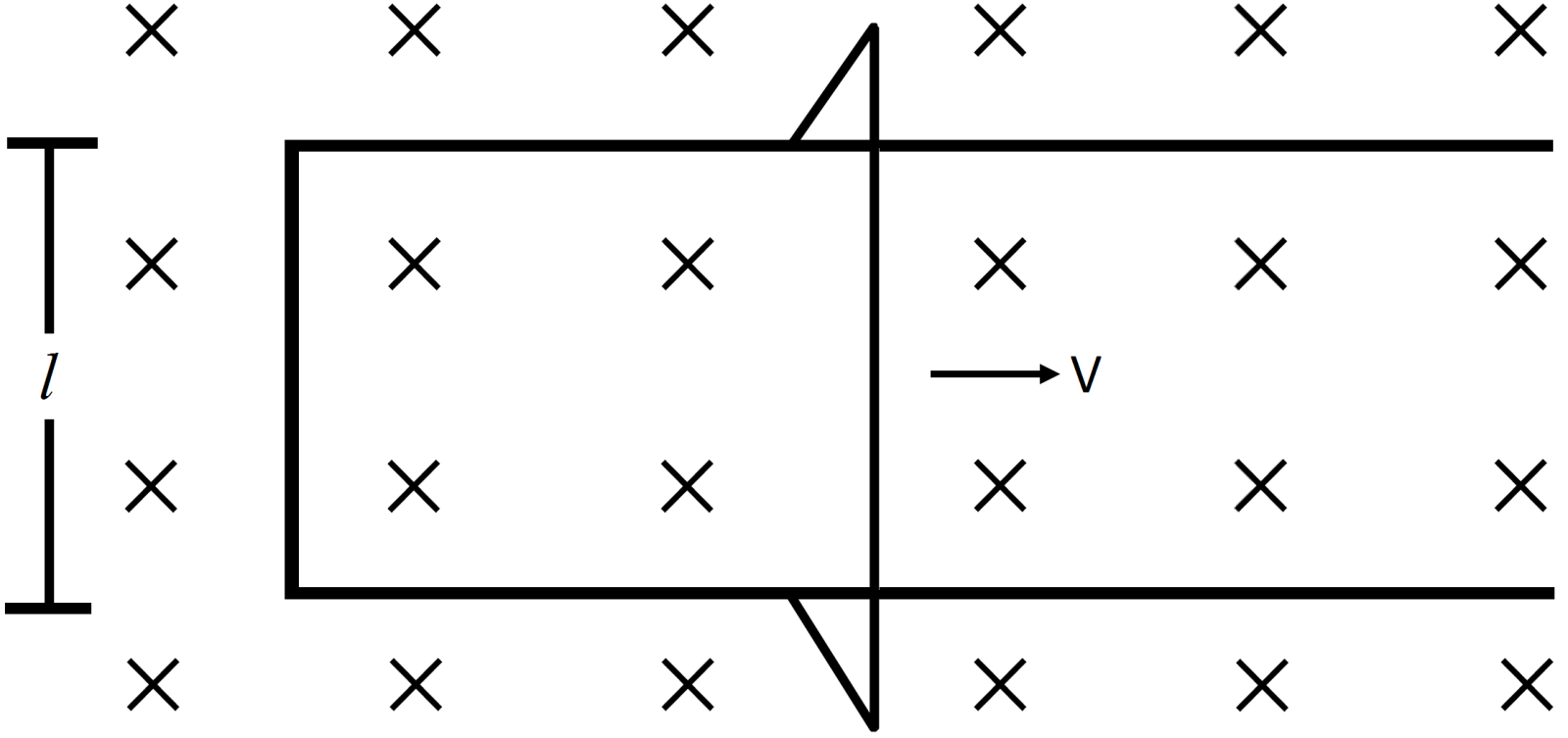
Figure shows a long U-shaped wire of width l placed in a perpendicular magnetic field B. A wire of length l is slid on the U-shaped wire with a constant velocity v towards right. The resistance of all the wires is r per unit length. At t = 0, the sliding wire is close to the left edge of the U-shaped wire. Draw an equivalent circuit diagram, showing the induced emf as a battery. Calculate the current in the circuit.
The separation between a node and the next antinode in a vibrating air column is 25cm. If the speed of sound in air is 340m/s, find the frequency of vibration of the air column.
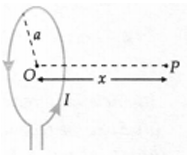
A student records the following data for the magnitudes $(B)$ of the magnetic field at axial points at different distances $x$ from the centre of a circular coil of radius a carrying a current $I$. Verify $($for any two$)$ that these observations are in good agreement with the expected theoretical variation of $B$ with $x$.
Image
$x \rightarrow$ $x = 0$ $x - a$ $x = 2 a$ $x = 3a$
$y \rightarrow$ $B _0$ $0.25 \sqrt{2} B_0$ $0.039 \sqrt{5} B_0$ $0.010 \sqrt{10} B_0$

 
In a long straight wire, a current of 5 A is flowing. How much magnetic field will be produced at a distance of 10 cm from it? Which rule will give the direction of the field?
A silver wire has a resistance of 2.1 Ω at 27.5${ }^{\circ} C$, and a resistance of 2.7 Ω at 100 ${ }^{\circ} C$. Determine the temperature coefficient of resistivity of silver.
The magnetic field inside a tightly wound, long solenoid is $\text{B}=\mu_0\text{ni}.$ It suggests that the field does not depend on the total length of the solenoid, and hence if we add more loops at the ends of a solenoid the field should not increase. Explain qualitatively why the extra-added loops do not have a considerable effect on the field inside the solenoid.
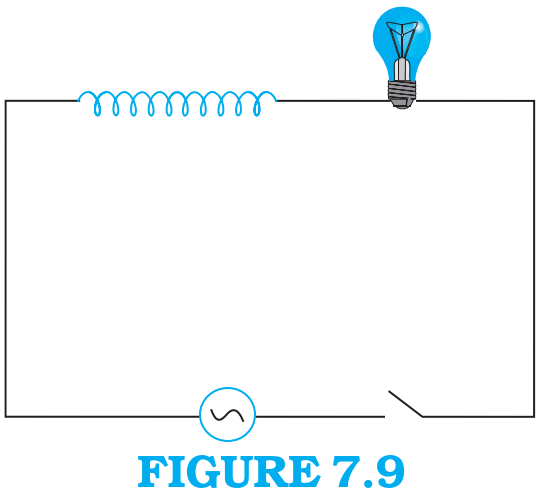
A light bulb and an open coil inductor are connected to an ac source through a key as shown in Fig. 7.9.
Image
The switch is closed and after sometime, an iron rod is inserted into the interior of the inductor. The glow of the light bulb (a) increases; (b) decreases; (c) is unchanged, as the iron rod is inserted. Give your answer with reasons.