Question
  1. Obtain the expression for the cyclotron frequency.
  2. A deuteron and a proton are accelerated by the cyclotron. Can both be accelerated with the same oscillator frequency? Give reason to justify your answer.

Answer

  1. $\frac{mv^2}{r}=qvB$
$r=\frac{mv}{qB}$

Frequency of revolution $(v)=\frac{1}{Time\text{ }period}=\frac{v}{2\pi r}$

$v=\frac{qB}{2\pi m}$
  1. No The mass of the two particles, i.e deuteron and proton, is different. Since (cyclotron) frequency depends inversely on the mass, they cannot be accelerated by the same oscillator frequency.

Need a full question paper?

Generate a complete, print-ready paper with questions like this in minutes — across 16+ boards, with answer keys.
Start Generating Free

Similar questions

$a.$ A toroidal solenoid with an air core has an average radius of $0.15 m$ , area of cross section $12 \times 10^{-4} m^2$ and $1200$ turns. Obtain the self inductance of the toroid. Ignore field variation across the cross section of the toroid.
$b.$ A second coil of $300$ turns is wound closely on the toroid above. If the current in the primary coil is increased from zero to $2.0 A$ in $0.05 s,$ obtain the induced emf in the secondary coil.
In a single slit diffraction experiment, a slit of width $d$ is illuminated by red light of wavelength $650 \ nm$. For what value of d will
$i.$ the first minimum fall is at an angle of diffraction of $30^\circ $ and
$ii.$ the first maximum fall is at an angle of diffraction of $30^\circ ?$
What is the de Broglie wavelength associated with $(a)$ an electron moving with a speed of $5.4 \times 10^6 m / s$, and $(b)$ a ball of mass $150 g$ travelling at $30.0 m / s$ ?
A charged capacitor of capacitance C is discharged through a resistance R. A radioactive sample decays with an average-life $\tau.$ Find the value of R for which the ratio of the electrostatic field energy stored in the capacitor to the activity of the radioactive sample remains constant in time.
Draw a clear and labelled diagram of an alternating current generator.
In a photoelectric experiment, the collector plate is at 2.0V with respect to the emitter plate made of copper ($\phi$ - 4.5eV). The emitter is illuminated by a source of monochromatic light of wavelength 200 run. Find the minimum and maximum kinetic energy of the photoelectrons reaching the collector.
Consider a non-conducting ring of radius r and mass m that has a total charge q distributed uniformly on it. The ring is rotated about its axis with an angular speed $\omega.$
  1. Find the equivalent electric current in the ring.
  2. Find the magnetic moment $\mu$ of the ring.
  3. Show that $\mu=\frac{\text{q}}{2\text{m}}\text{l}$ where l is the angular momentum of the ring about its axis of rotation.
Should the energy of a photon be called its kinetic energy or its internal energy?

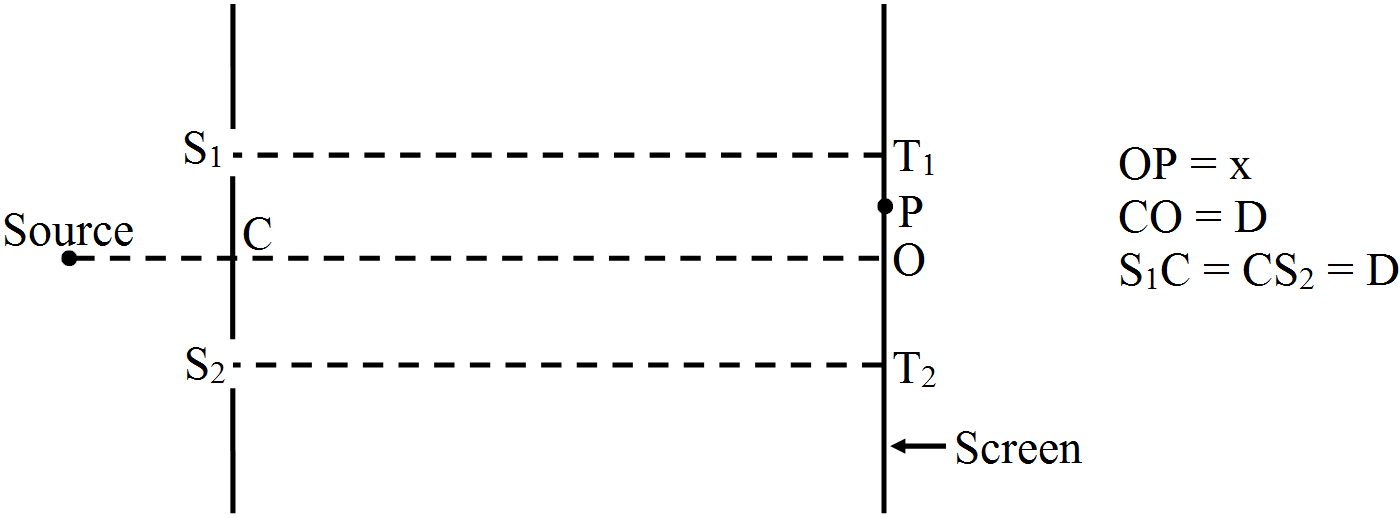
Consider a two slit interference arrangements such that the distance of the screen from the slits is half the distance between the slits.

Obtain the value of D in terms of $\lambda$ such that the first minima on the screen fall at a distance D from the centre O.
Two charged conducting spheres of radii a and b are connected to each other by a wire. What is the ratio of electric fields at the surfaces of the two spheres? Use the result obtained to explain why charge density on the sharp and pointed ends of a conductor is higher than on its flatter portions.