MCQ
Oersted is a unit of
  • A
    Dip
  • Magnetic intensity
  • C
    Magnetic moment
  • D
    Pole strength

Answer

Correct option: B.
Magnetic intensity
b
(b) $1$ Oerstead $= 1$ Gauss $=$ ${10^{ - 4}}Tesla$

Need a full question paper?

Generate a complete, print-ready paper with questions like this in minutes — across 16+ boards, with answer keys.
Start Generating Free

Similar questions

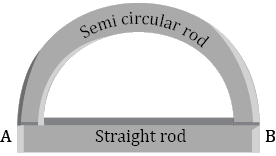
Two rods (one semi-circular and other straight) of same material and of same cross-sectional area are joined as shown in the figure. The points $A$ and $B$ are maintained at different temperature. The ratio of the heat transferred through a cross-section of a semi-circular rod to the heat transferred through a cross section of the straight rod in a given time is
The function ${\sin ^2}(\omega t)$ represents
A planet having mass $9\,Me$ and radius $4 R _e$, where Me and $\operatorname{Re}$ are mass and radius of earth respectively, has escape velocity in $km / s$ given by:(Given escape velocity on earth $\left.V_e=11.2 \times 10^3\,m / s \right)$
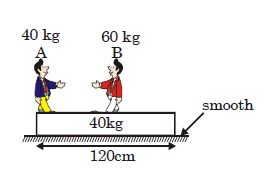
Two men $‘A’$ and $‘B’$ are standing on a plank. $‘B’$ is at the middle of the plank and $‘A’$ is at the left end of the plank. System is initially at rest and masses are as shown in figure. $‘A’$ and $‘B’$ starts moving such that the position of $‘B’$ remains fixed with respect to ground till $‘A’$ meets $‘B’$ . Then the point where $A$ meets $B$ is located at 
The force required just to move a body up an inclined plane is double the force required just to prevent the body from sliding down. If $\mu $ is the coefficient of friction, the inclination of plane to the horizontal is
A long stiff uniform wire is suspended from one end. The time period of oscillations of the wire is $T$. If the wire is now bent into a circle and suspended from a knife edge so that it can oscillate freely in the plane of the ring, its time period will be
If the tension and diameter of a sonometer wire of fundamental frequency $n$ are doubled and density is halved then its fundamental frequency will become
The velocity of a particle moving on the $x-$ axis is given by $v = x^2 + x$ where $v$ is in $m/s$ and $x$ is in $m$ . Find its acceleration in $m/s^2$ when passing through the point $x = 2m$
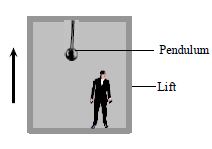
A man measures the period of a simple pendulum inside a stationary lift and finds it to be $T$ $s$. If the life accelerates upwards with an acceleration $g/4$, then the period of the pendulum will be
Particle $A$ of mass $m _{1}$ moving with velocity $(\sqrt{3} \hat{i}+\hat{j})\, ms ^{-1}$ collides with another particle $B$ of mass $m _{2}$ which is at rest initially. Let $\overrightarrow{ V }_{1}$ and $\overrightarrow{ V }_{2}$ be the velocities of particles $A$ and $B$ after collision respectively. If $m _{1}=2\, m _{2}$ and after collision $\overrightarrow{ V }_{1}=(\hat{ i }+\sqrt{3} \hat{ j })\, ms ^{-1},$ the angle between $\overrightarrow{ V }_{1}$ and $\overrightarrow{ V }_{2}$ is$......^o$