MCQ
Of the following, the compound possessing optical isomerism
- A$C{H_3}C{H_2}OH$
- ✓$C{H_3}CHClBr$
- C$CC{l_2}BrF$
- D$CC{l_2}{F_2}$
Generate a complete, print-ready paper with questions like this in minutes — across 16+ boards, with answer keys.
$1 \mathrm{~mol}$ of an ideal gas is kept in a cylinder, fitted with a piston, at the position $\mathrm{A}$, at $18^{\circ} \mathrm{C}$. If the piston is moved to position $B$, keeping the temperature unchanged, then ' $x$ ' $L$ atm work is done in this reversible process.
$\mathrm{x}=$ . . . . . . $\mathrm{L} \mathrm{atm.} \mathrm{(nearest} \mathrm{integer)}$
[Given : Absolute temperature $={ }^{\circ} \mathrm{C}+273.15$, $\left.\mathrm{R}=0.08206 \mathrm{~L} \mathrm{~atm} \mathrm{~mol}^{-1} \mathrm{~K}^{-1}\right]$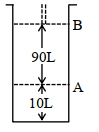
$A_{2(g)} + B_{2(g)} \rightleftharpoons 2AB_{(g)}$
At equilibrium, the concentration of $A_2= 3.0 \times 10^{-3} \, M,$ of $B_2= 4.2 \times 10^{-3} \, M,$ of $AB= 2.8 \times 10^{-3} \, M,$
If the reaction takes place in a sealed vessel at $527^o C,$ then the value of $K_c$ will be