MCQ
Of the following, which has three electron bond in its structure
- ANitrous oxide
- ✓Nitric oxide
- CDinitrogen trioxide
- DNitrogen pentoxide
So, Nitric Oxide has one $3$-electron bond in i's structure.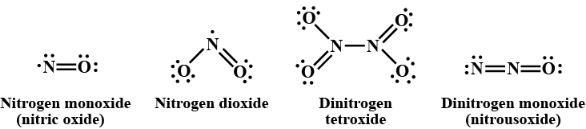
Generate a complete, print-ready paper with questions like this in minutes — across 16+ boards, with answer keys.
$(a)\ Pb^{+2} > Pb^{+4} , Tl^{+1} < Tl^{+3}$
$(b)\ Bi^{+3} < Sb^{+3 }, Sn^{+2} < Sn^{+4}$
$(c)\ Pb^{+2} > Pb^{+4} , Bi^{+3} > Bi^{+5}$
$(d)\ Tl^{+3} < In^{+3} , Sn^{+2} > Sn^{+4}$
$(e)\ Sn^{+24} < Pb^{+2} , Sn^{+4} > Pb^{+4}$
$(f)\ Sn^{+2} < Pb^{+2} , Sn^{+4} < Pb^{+4}$
| Column $I$ | Column $II$ |
| $(A)$ $\mathrm{C}_6 \mathrm{H}_5 \mathrm{CHO}$ | $(p)$ gives precipitate with $2, 4$-dinitrophenylhydrazine |
| $(B)$ $\mathrm{CH}_3 \mathrm{C} \equiv \mathrm{CH}$ | $(q)$ gives precipitate with $\mathrm{AgNO}_3$ |
| $(C)$ $\mathrm{CN}^{-}$ | $(r)$ is a nucleophile |
| $(D)$ $\mathrm{I}^{-}$ | $(s)$ is involved in cyanohydrin formation |