MCQ
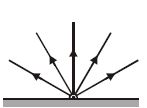
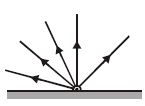
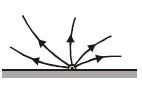
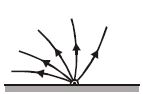
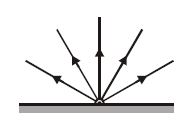
On a windless day, sound emanate isotropically from a point source. Rays of the sound waves emanated from a point source placed close to ground are shown in the figure. Consider horizontal wind towards the left blowing with constant velocity, which is uniform everywhere. In the following figures, rays of sound waves in presence of the wind are shown. Which one is the most correct representation?
  • A

  • B


  • D

Answer

Correct option: C.

c
Velocity of sound depends on velocity of medium as $(v_s)_m = v_s ± v_m$ Here wave front is shifted to left side

Need a full question paper?

Generate a complete, print-ready paper with questions like this in minutes — across 16+ boards, with answer keys.

Start Generating Free

Similar questions

A reversible engine and an irreversible engine are working between the same temperatures. The efficiency of the ...........
The planet Mars has two moons, if one of them has a period $7\, hours,\, 30\, minutes$ and an orbital radius of $9.0 \times 10^{3}\, {km} .$ Find the mass of Mars.

$\left\{\operatorname{Given} \frac{4 \pi^{2}}{G}=6 \times 10^{11} {N}^{-1} {m}^{-2} {kg}^{2}\right\}$

At a temperature $T K,$ the pressure of $4.0\,\,g$ argon in a bulb is $p$. The bulb is put in a bath having temperature higher by $50\,\,K$ than the first one. $0.8\,\,g$ of argon gas had to be removed to maintained original pressure. The temperature $T$ is equal to ..... $K$
An aeroplane is flying at a constant horizontal velocity of $600\, km/hr $ at an elevation of $6\, km$ towards a point directly above the target on the earth's surface. At an appropriate time, the pilot releases a ball so that it strikes the target at the earth. The ball will appear to be falling
The density of a non-uniform rod of length 1m is given by $\rho(\text{x})=\alpha(1+\text{b}\text{x}^2)$ where a and b are constants and $0\leq\text{x}\leq1$ The centre of mass of the rod will be at:
Select the correct statement about the reflection and refraction of a wave at the interface between the medium $1$ and $2$ the
A string of length $1\,\,m$ and linear mass density $0.01\,\,kgm^{-1}$ is stretched to a tension of $100\,\,N.$ When both ends of the string are fixed, the three lowest frequencies for standing wave are $f_1, f_2$ and $f_3$. When only one end of the string is fixed, the three lowest frequencies for standing wave are $n_1, n_2$ and $n_3$. Then
If momentum (P), area (A) and time (T) are taken to be fundamental quantities, then energy has the dimensional formula:
A ring of diameter $2m$ oscillates as a compound pendulum about a horizontal axis passing through a point at its rim. It oscillates such that its centre move in a plane which is perpendicular to the plane of the ring. The equivalent length of the simple pendulum is .... $m$
Two blocks $1$ and $2$ of equal mass $m$ are connected by an ideal string (see figure below) over a frictionless pulley. The blocks are attached to the ground by springs having spring constants $k_1$ and $k_2$ such that $k_1 > k_2$. Initially, both springs are unstretched. Block $1$ is slowly pulled down a distance $x$ and released. Just after the release the possible values of the magnitudes of the accelerations of the blocks $a_1$ and $a_2$ can be