MCQ
On adding excess of $N{H_3}$ solution to $CuS{O_4}$ solution, the dark blue colour is due to
  • ${\left[ {Cu{{(N{H_3})}_4}} \right]^{ + 2 }}$
  • B
    ${\left[ {Cu{{(N{H_3})}_2}} \right]^{ + 2 }}$
  • C
    ${\left[ {Cu(N{H_3})} \right]^ + }$
  • D
    None of the above

Answer

Correct option: A.
${\left[ {Cu{{(N{H_3})}_4}} \right]^{ + 2 }}$
a
(a)$CuS{O_4} + 4N{H_3}\, \to \,{[Cu{(N{H_3})_4}]^{ + 2 }}SO_4^{ - \, - }$

Need a full question paper?

Generate a complete, print-ready paper with questions like this in minutes — across 16+ boards, with answer keys.

Start Generating Free

Similar questions

Faraday's 2nd law states that mass deposited on the electrode is directly proportional to
Antibodies are
Consider th following four reactions:

$(I)$ $\begin{array}{*{20}{c}}
  {{C_6}{H_5} - CH - Cl} \\ 
  {\,\,|} \\ 
  {\,\,\,\,\,\,\,\,\,C{H_3}} 
\end{array}\xrightarrow[{5\% \,\,water}]{{95\% \,\,\,acetone}}\begin{array}{*{20}{c}}
  {{C_6}{H_5} - CH - OH} \\ 
  | \\ 
  {\,\,\,\,\,\,C{H_3}} 
\end{array}$

$(II)$ $\begin{array}{*{20}{c}}
  {{C_6}{H_5} - CH - Cl} \\ 
  {\,\,|} \\ 
  {\,\,\,\,\,\,C{H_3}} 
\end{array}\xrightarrow[{10\% \,\,water}]{{90\% \,\,\,acetone}}\begin{array}{*{20}{c}}
  {{C_6}{H_5} - CH - OH} \\ 
  | \\ 
  {\,\,\,\,\,\,C{H_3}} 
\end{array}$

$(III)$ $\begin{array}{*{20}{c}}
  {{C_6}{H_5} - CH - Cl} \\ 
  {\,\,|} \\ 
  {\,\,\,\,\,\,C{H_3}} 
\end{array}\xrightarrow[{20\% \,\,water}]{{80\% \,\,\,acetone}}\begin{array}{*{20}{c}}
  {{C_6}{H_5} - CH - OH} \\ 
  | \\ 
  {\,\,\,\,\,\,C{H_3}} 
\end{array}$

$(IV)$ $\begin{array}{*{20}{c}}
  {{C_6}{H_5} - CH - Cl} \\ 
  {\,\,|} \\ 
  {\,\,\,\,\,\,C{H_3}} 
\end{array}\xrightarrow{{100\% \,water}}\begin{array}{*{20}{c}}
  {{C_6}{H_5} - CH - OH} \\ 
  | \\ 
  {\,\,\,\,\,\,C{H_3}} 
\end{array}$

Arrange these reactions in decreasing order of greater proportion of inverted product and select correct answer from the codes given below :
Thallium shows different oxidation states because
Which class of compounds shows H-bonding even more than in alcohols
Unlike other halogens fluorine does not show higher oxidation states because
Which of the following compound does not give Aldol condensation reaction ?
Which $\beta$ - keto acid shown will not undergo decarboxylation ?
When $20 \mathrm{~g}$ of naphthoic acid $\left(\mathrm{C}_{11} \mathrm{H}_8 \mathrm{O}_2\right)$ is dissolved in $50 \mathrm{~g}$ of benzene $\left(\mathrm{K}_{\mathrm{f}}=1.72 \mathrm{~K} \mathrm{~kg} \mathrm{~mol}^{-1}\right)$, a freezing point depression of $2 \mathrm{~K}$ is observed. The van't Hoff factor $(i)$ is
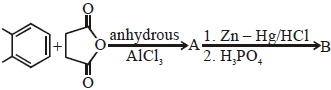
In the following reaction sequence the major products $A$ and $B$ are