Question
On increasing the current drawn from a cell, the net potential difference across its terminals is lowered, why?

Answer

The terminal potential difference V = E - Ir.
Clearly if I is increased, the terminal potential difference falls.

Need a full question paper?

Generate a complete, print-ready paper with questions like this in minutes — across 16+ boards, with answer keys.

Start Generating Free

Similar questions

If an electron has a wavelength, does it also have a colour?
Complete the following decay schemes.
  1. $\text{ }^{226}_{88}\text{Ra}\rightarrow\alpha+$
  2. $\text{ }^{19}_8\text{O}\rightarrow\text{ }^{19}_9\text{F}+$
  3. $\text{ }^{25}_{13}\text{Al}\rightarrow\text{ }^{25}_{12}\text{Mg}+$
Two satellites going in equatorial plane have almost same radii. As seen from the earth one moves from east to west and the other from west to east. Will they have the same time period as seen from the earth? If not, which one will have less time period?
A source emits 31.4W of radiant flux distributed uniformly in all directions. The luminous efficiency is 60 lumen/ watt. What is the luminous intensity of the source?
(a) When monochromatic light is incident on a surface separating two media, the reflected and refracted light both have the same frequency as the incident frequency. Explain why?
(b) When light travels from a rarer to a denser medium, the speed decreases. Does the reduction in speed imply a reduction in the energy carried by the light wave?
(c) In the wave picture of light, intensity of light is determined by the square of the amplitude of the wave. What determines the intensity of light in the photon picture of light.
Write the name of optical instruments.
Suppose, we think of fission of a $^{56}_{26}\text{Fe}$ nucleus into two equal fragments, $^{28}_{13}\text{Al}.$ Is the fission energetically possible? Argue by working out Q of the process. Given $\text{m}(^{56}_{26}\text{Fe})=55.93494\text{ u and m }(^{28}_{13}\text{Al})=27.98191\text{ u}.$
A railroad car of mass M is at rest on frictionless rails when a man of mass m starts moving on the car towards the engine. If the car recoils with a speed v backward on the rails, with what velocity is the man approaching the engine?
A point charge produces an electric field of magnitude 5.0NC-1 at a distance of 40cm from it. What is the magnitude of the charge?
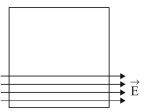
A square surface of side L meter is kept in the plane of the paper. A uniform elecrtric field $\overrightarrow{ E }$ is also present in the plane of the paper and it is limited to the lower half of the page as shown in the figure. What will be the electric flux bound to the surface?Image