MCQ
On passing the current in water voltameter, the hydrogen
  • A
    Liberated at anode
  • Liberated at cathode
  • C
    Does not liberate
  • D
    Remains in the solution

Answer

Correct option: B.
Liberated at cathode
(b) Because $H$ has positive charge.

Need a full question paper?

Generate a complete, print-ready paper with questions like this in minutes — across 16+ boards, with answer keys.
Start Generating Free

Similar questions

The time period of a simple pendulum measured inside a stationary ift is found to be $T$. If the lift starts accelerating upwards with an acceleration $g / 3$, the time period is
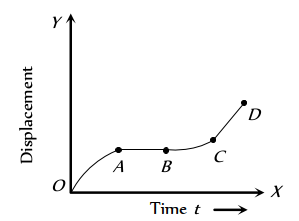
The graph between the displacement $x$ and time $t$ for a particle moving in a straight line is shown in figure. During the interval $O A, A B, B C$ and $C D$, the acceleration of the particle is
Image
An equiconvex lens of glass of focal length $0.1$ metre is cut along a plane perpendicular to principle axis into two equal parts. The ratio of focal length of new lenses formed is
[SCRA 1994]
A set of $n$ identical cubical blocks lies at rest parallel to each other along a line on a smooth horizontal surface. The separation between the near surfaces of any two adjacent blocks is $L$. The block at one end is given a speed $v$ towards the next one at time $t=0$. All collisions are completely inelastic, then
  1. The last block starts moving at $t=\frac{(n-1) L}{v}$
  2. The last block starts moving at $t=\frac{n(n-1) L}{2 v}$
  3. The centre of mass of the system will have a final speed $v$
  4. The centre of mass of the system will have a final speed $\frac{v}{n}$
The radius of curvature for a convex lens is $40 \mathrm{~cm}$, for each surface. Its refractive index is $1.5$ The focal length will be
Water is flowing in a pipe of diameter $4 cm$ with a velocity $3 m / s$. The water then enters into a tube of diameter $2 cm$. The velocity of water in the other pipe is
Which of the following statements is not true
Critical angle of light passing from glass to air is minimum for
coin is dropped in a lift. It takes time $t_1$ to reach the floor when ift is stationary. It takes time $t_2$ when lift is moving up with constant acceleration. Then