MCQ
On the interval $I = [- 2, 2]$, the function

$f(x) =$ $\left\{ {\begin{array}{*{20}{c}}   {(x\, + \,1)\,\,{e^{ - \,\left[ {\tfrac{1}{{|x|}}\,\, + \,\,\tfrac{1}{x}} \right]}}}&{(x\,\, \ne \,\,0)} \\    {0\,\,\,\,\,\,\,\,\,\,\,\,\,\,\,\,\,\,\,\,\,\,\,\,\,\,\,\,\,}&{(x\,\, = \,\,0)} \end{array}} \right.$

then which one of the following does not hold good ?

  • is continuous for all values of $x \in I$
  • B
    is continuous for $x \in I - (0)$
  • C
    assumes all intermediate values from $f(- 2) \& f(2)$
  • D
    has a maximum value equal to $3/e$ .

Answer

Correct option: A.
is continuous for all values of $x \in I$
a
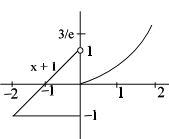
$f (x) =$  $\left[ \begin{gathered}  (x + 1){e^{ - 2/x}}\,\,\,\,\,if\,\,\,x > 0 \hfill \\  x + 1\,\,\,\,\,\,\,\,\,\,\,\,\,\,\,\,\,\,\,\,if\,\,\,x\, < \,0 \hfill \\  0\,\,\,\,\,\,\,\,\,\,\,\,\,\,\,\,\,\,\,\,\,\,\,\,\,\,if\,\,\,\,x\, = \,0\, \hfill \\ \end{gathered}  \right.$

the graph of $f (x)$ is

hence $f$ can assume all values for $f (- 2) to f (2)$

Need a full question paper?

Generate a complete, print-ready paper with questions like this in minutes — across 16+ boards, with answer keys.

Start Generating Free

Similar questions

$\int_{}^{} {\frac{{{x^{e - 1}} + {e^{x - 1}}}}{{{x^e} + {e^x}}}dx = } $
The function $f\left( x \right) = \left| {\sin \,4x} \right| + \left| {\cos \,2x} \right|$, is a periodic function with period
The solution of the differential equation  $xdy + ydx -$ $\sqrt {1 - {x^2}{y^2}} dx = 0$ is
Solution of the differential equation $\frac{{dy}}{{dx}}\tan y = \sin (x + y) + \sin (x - y)$ is
Let $f: R \rightarrow R$ be a function such that $f(x+y)=f(x)+f(y), \quad \forall x, y \in R .$ If $f(x)$ is differentiable at $x=0$, then

$(A)$ $f(x)$ is differentiable only in a finite interval containing zero

$(B)$ $f(x)$ is continuous $\forall x \in R$

$(C)$ $f^{\prime}(x)$ is constant $\forall x \in R$

$(D)$ $f(x)$ is differentiable except at finitely many points

$\int\frac{1}{1-\cos\text{x}-\sin\text{x}}\text{ dx}=$
The population $p (t)$ at time $t$ of a certain mouse species satisfies the differential equation $\frac{{dp\left( t \right)}}{{dt}} = 0.5p\left( t \right) - 450$ . If $p\left( 0 \right) = 850$ then the time at which the population becomes zero is :
The radius of a sphere is increasing at the rate of 0.2cm/sec. The rate at which the volume of the sphere increase when radius is 15cm, is:
The function $f(x)=\frac{x}{x^2-6 x-16}, x \in \mathbb{R}-\{-2,8\}$
If $\int \frac{\mathrm{d} \theta}{\cos ^{2} \theta(\tan 2 \theta+\sec 2 \theta)}=\lambda \tan \theta+2 \log _{\mathrm{e}}|\mathrm{f}(\theta)|+\mathrm{C}$  where $\mathrm{C}$ is a constant of integration, then the ordered pair $(\lambda, f(\theta))$ is equal to