Question
On what factors does the resolving power of a microscope depend? How can it be increased?

Answer

Resolving power of a microscope
$
=\frac{2 n \sin a }{\lambda}=\frac{2 NA }{\lambda}
$
where, $\alpha \equiv$ the half angle of the angular separation between the objects at the objective lens. $n \equiv$ the refractive index of the medium between the object and the objective, $\lambda \equiv$ the wavelength of the light used to illuminate the object, $N A=n \sin \alpha=$ the numerical aperture of the objective.
Thus, the resolving power of a microscope depends directly on the NA and inversely on $\lambda$. The resolving power is increased by:
1. increasing the numerical aperture using oil-immersion objective.
2. illuminating the object with smaller wavelength radiation. But our eyes are not very sensitive to the shorter wavelength blue end of the visible spectrum. Hence, ultraviolet radiation is used for illumination with quartz lenses, but then photographs must be taken to examine the image.

Need a full question paper?

Generate a complete, print-ready paper with questions like this in minutes — across 16+ boards, with answer keys.
Start Generating Free

Similar questions

A horizontal force of $1 N$ is required to move a metal plate of area $10^{-2} m ^2$ with a velocity of $2 \times 10^{-2} m / s$, when it rests on a layer of oil $1.5 \times 10^{-3} m$ thick. Find the coefficient of viscosity of oil.
What are the conditions for obtaining good interference pattern? Give reasons.
Derive expressions for the period of SHM in terms of
(1) angular frequency
(2) force constant
(3) acceleration.
A parallel beam of monochromatic light is incident on a glass slab at an angle of incidence $60^{\circ}$. Find the ratio of the width of the beam in glass to that in air if the refractive index of glass is $\frac{3}{2}$.
Data: $i =60, a n _g=1.5$
By Snell's law, ang $=\frac{\sin i}{\sin r} \therefore \sin r=\frac{\sin i}{\operatorname{sn} n_g}$
Obtain the expression for the applied emf and the effective resistance of the circuit when alternating emf is applied to an LR circuit.
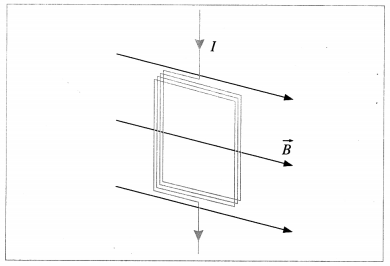
A rectangular coil of $10$ turns, each of area $0.05 m ^2,$ is suspended freely in a uniform magnetic field of induction $0.01 T$. A current of $30 \ ( A$ is passed through$)$ it.
Image
$(i)$ What is the magnetic moment of the coil?
$(ii)$ What is the maximum torque experienced by the coil?
$(iii)$ What is the minimum torque experienced by the coil?
On a dry day, the maximum safe speed at which a car can be driven on a curved horizontal road without skidding is $7 \mathrm{~m} / \mathrm{s}$. When the road is wet, the frictional force between the tyres and road reduces by $25 \%$. How fast can the car safely take the turn on the wet road?
A compound object is formed of a thin rod and a disc attached at the end of the rod. The rod is $0.5 \mathrm{~m}$ long and has mass $2 \mathrm{~kg}$. The disc has mass of $1 \mathrm{~kg}$ and its radius is $20 \mathrm{~cm}$. Find the moment of inertia of the compound object about an axis passing through the free end of the rod and perpendicular to its length.
A solar cooker and a pressure cooker both are used to cook food. Treating them as thermodynamic systems, discuss the similarities and differences between them.
A circular disc of moment of inertia $10 \mathrm{~kg} \cdot \mathrm{m}^2$ is rotated about its transverse symmetry axis at a constant frequency of $60 \mathrm{rpm}$ by an electric motor of power 31.42 watts. When the motor is switched off, how many rotations does it complete before coming to rest?