MCQ
One atmosphere is equal to
  • $101.325\, K pa$
  • B
    $1013.25 \,K pa$
  • C
    ${10^5}\,Nm$
  • D
    None of these

Answer

Correct option: A.
$101.325\, K pa$
a
One Pascal is the pressure exerted by a force of one newton, normally on an area of one square meter.

Atmospheric pressure is the force per unit area by the weight of air on a point. One atmospheric pressure is related with the Pascal as: $1 \,atm =101325 \,Pa$

Need a full question paper?

Generate a complete, print-ready paper with questions like this in minutes — across 16+ boards, with answer keys.

Start Generating Free

Similar questions

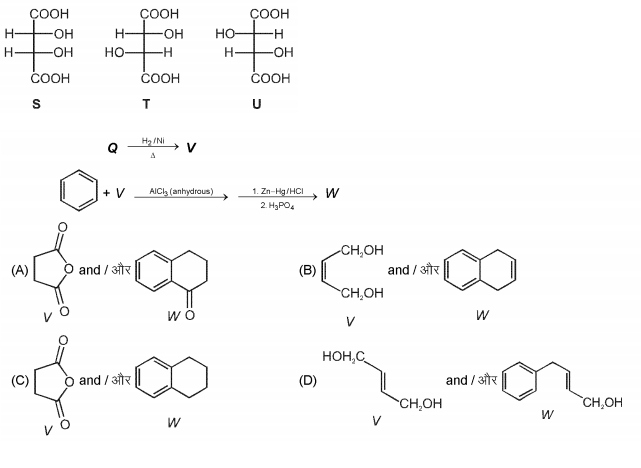
$P$ and $Q$ are isomers of dicarboxylic acid $C _4 H _4 O _4$. Both decolorize $Br _2 / H _2 O$. On heating, $P$ forms the cyclic anhydride.

Upon treatment with dilute alkaline $KMnO _4, P$ as well as $Q$ could produce one or more than one from $S , T$ and $U$.$Image$

$1.$ Compounds formed form $P$ and $Q$ are, respectively

$(A)$ Optically active $S$ and optically active pair $(T, U)$

$(B)$ Optically inactive $S$ and optically inactive pair $(T, U)$

$(C)$ Optically active pair $(T, U)$ and optically active $S$

$(D)$ Optically inactive pair $(T, U)$ and optically inactive $S$

$2.$ In the following reaction sequences $V$ and $W$ are respectively :$Image$

mcq $Image$

Give the answer question $1$ and $2.$
$pH$ of $10^{-8}\, M$ $Ba(OH)_2$ solution will be
Which solution will have the highest boiling point
How many mole of electrons are needed to convert one mole of nitrate ion to hydrazine ?
Reduction potential of ions are given below:

$ClO_4^{-}$  $IO_4^{-}$ $BrO_4^{-}$ 
$E^{\circ}=1.19 V$  $E^{\circ}=1.65 V$ $E^{\circ}=1.74 V$

 The correct order of their oxidising power is:

Which one of the following statement for order of reaction is not correct
The $IUPAC$ name of picric acid is
If the total energy of an electron in a hydrogen atom in excited state is $-3.4\, eV$, then the de-Broglie wavelength of the electron is
Find the highest ratio of $IP$ values of given pair of elements
One mole of an ideal gas expands isothermally and reversibly from $10 \mathrm{dm}^{3}$ to $20 \mathrm{dm}^{3}$ at $300 \mathrm{~K} . \Delta \mathrm{U}$, q and work done in the process respectively are :
Given : $\mathrm{R}=8.3 \mathrm{JK}^{-1}$ and $\mathrm{mol}^{-1}$
In $10=2.3$
$\log 2=0.30$
$\log 3=0.48$