MCQ
One atomic mass units is equivalent to .............. $MeV$ energy.
  • A
    $39$
  • B
    $93$
  • C
    $139$
  • $931.5$

Answer

Correct option: D.
$931.5$
d
$1\, a.m.u$ is defined as $1 / 12^{\text {th }}$ of the mass of an atom of $6^{ C ^{12}}$ isotope.

It can be shown that

1 a.m.u $=1.66 \times 10^{27}\,kg$.

According to Einstein, mass energy equivalence

$E = mc ^2$

Where $m =1.66 \times 10^{-27}\, kg$

$C =3 \times 10^8\, m / sec$, we get

$E =1.49 \times 10^{-10}\, J \left(1 Mev =1.6 \times 10^{-13}\, J \right)$

$E =\frac{1.49 \times 10^{-10}\, J }{1.6 \times 10^{-13}}\,Mev$

$E =931.25\,Mev$

Hence a change in mass of $1\,a. m.u$ (called mass defect) releases an energy equal to $931 \,Mev$.

$1\,amu =931\,Mev$ is used as a standard conversion.

Need a full question paper?

Generate a complete, print-ready paper with questions like this in minutes — across 16+ boards, with answer keys.
Start Generating Free

Similar questions

A point traversed $3 / 4$ th of the circle of radius $R$ in time $t$. The magnitude of the average velocity of the particle in this time interval is
A particle of mass $10\ kg$ is moving in a straight line. If its displacement, $x$ with time $t$ is given by $x = (t^3 - 2t - 10)m,$ then the force acting on it at the end of $4$ seconds is:
A body is moving with velocity $30\; m/s$ towards east. After $10$ seconds its velocity becomes $40\; m/s$ towards north. The average acceleration of the body is ...... $m/s^2$
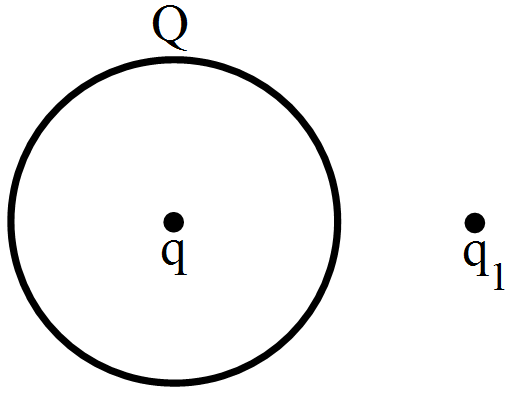
A thin, metallic spherical shell contains a charge $Q$ on it. A point charge $q$ is placed at the centre of the shell and another charge $q_1$ is placed outside it as shown in figure. All the three charges are positive. The force on the charge at the centre is:
A dip circle is taken to geomagnetic equator. The needle is allowed to move in a vertical plane perpendicular to the magnetic meridian. The needle will stay:
The force required to take away a flat circular plate of radius $2\, cm$ from the surface of water, will be (the surface tension of water is $70\, dyne/cm$)
$Assertion$ : The velocity of a body at the bottom of an inclined plane of given height is more when it slides down the plane, compared to, when it rolling down the same plane.
$Reason$ : In rolling down a body acquires both, kinetic energy of translation and rotation
A sounding body of negligible dimension emitting a frequency of $150\,\, Hz$ is dropped from a height. During its fall under gravity it passes near a balloon moving up with a constant velocity of $2m/s$ one second after it started to fall.The difference in the frequency observed by the man in balloon just before and just after crossing the body will be : (Given that -velocity of sound $= 300m/s; g = 10m/s^2$)
Why the dam of water reservoir is thick at the bottom
Which of the following is the graph between the height $(h)$ of a projectile and time $(t)$, when it is projected from the ground