MCQ
One calorie is equal to
  • A
    $0.4184 $ $Joule$
  • $4.184$ $Joule$
  • C
    $41.84 $ $Joule$
  • D
    $418.4$  $Joule$

Answer

Correct option: B.
$4.184$ $Joule$
b
We need to find $1$ calorie is equal to how many joules.

A calorie is the amount of energy that is supplied in the nutrients that make up food. Because it is a form of energy, calories can be converted to joules through a measurement of heat.

$1$ calorie $=4.186$ joules. is the required answer.

Need a full question paper?

Generate a complete, print-ready paper with questions like this in minutes — across 16+ boards, with answer keys.

Start Generating Free

Similar questions

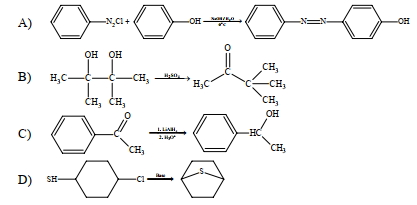
Match the reactions in Column $I$ with appropriate options in Column $II$.
Column $I$ Column $II$
$(A)$ $Image$ $(p)$ Racemic mixture
$(B)$ $Image$ $(q)$ Addition reaction
$(C)$ $Image$ $(r)$ Substitution reaction
$(D)$ $Image$ $(s)$ Coupling reaction
  $(t)$ Carbocation intermediate

At $-20^{\circ} \mathrm{C}$ and $1 \mathrm{~atm}$ pressure, a cylinder is filled with equal number of $\mathrm{H}_2 . \mathrm{I}_2$ and $\mathrm{HI}$ molecules for the reaction

$\mathrm{H}_2(\mathrm{~g})+\mathrm{I}_2(\mathrm{~g}) \rightleftharpoons 2 \mathrm{HI}(\mathrm{g})$, the $\mathrm{K}_{\mathrm{p}}$ for the process is $\mathrm{x} \times 10^{-1} \cdot \mathrm{x}=$ $\qquad$

[Given : $\mathrm{R}=0.082 \mathrm{~L} \mathrm{~atm} \mathrm{~K}^{-1} \mathrm{~mol}^{-1}$ ]

Standard electrode potential of $NHE$ at $298\,K$ is  .............. $\mathrm{V}$
A reagent which gives brilliant red precipitate with Nickel ions in basic medium is
The number of $2-$ centre $-2-$ electron and $3-$ centre $-2-$ electron bonds in $B_2H_6$, respectively, are
Splitting of spectral lines under the influence of magnetic field is called
Which of the following hydrogen halides has the highest boiling point
Aqueous solution of $FeSO_4$ gives tests for both $Fe^{2+}$ and $SO_4^{2-}$ but after addition of excess of $KCN,$ solution ceases to give test for $Fe^{2+}.$ This is due to the formation of
Which of the following compounds will absorb the maximum quantity of heat when dissolved in the same amount of water ? The heats of solution of these compounds at ${25\,^o}C$ in $ kJ/mole$  of each solute is given in brackets
$\begin{array}{*{20}{c}}
  {{{(C{H_3})}_2}C.C{H_2}.CO.C{H_3}} \\ 
  {\,\,\,\,|\,\,\,\,\,\,\,\,\,\,\,\,\,} \\ 
  {\,\,\,\,N{H_2}\,\,\,\,\,\,\,} 
\end{array}$  is