MCQ
One fermi is $...$
  • ${10^{ - 13}} \,cm$
  • B
     ${10^{ - 15}}\, cm$
  • C
    ${10^{ - 10}}\, cm$
  • D
    ${10^{ - 12}}\,  cm$

Answer

Correct option: A.
${10^{ - 13}} \,cm$
a
one fermi $=\frac{10^{-15}}{100}=10^{-13} \,cm$

Need a full question paper?

Generate a complete, print-ready paper with questions like this in minutes — across 16+ boards, with answer keys.
Start Generating Free

Similar questions

Which gives $C{H_4}$ when treated with water
Which of the following molecular orbitals has two nodal planes
Compounds which can show both optical as well as geometrical isomerism
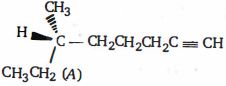
Which combination is best for preparation of the compound $(A)$ shown below ?
Thiosulphate reacts differently with iodine and bromine in the reactions given below:
$2\text{S}_2\text{O}^{2-}_3+\text{I}\xrightarrow{ \ \ \ \ \ \ \ }\text{S}_4\text{O}^{2-}_6+2\text{I}^{-}$
$\text{S}_2\text{O}^{2-}_3+2\text{Br}_2+5\text{H}_2\text{O}\xrightarrow{ \ \ \ \ \ \ \ }2\text{SO}^{2-}_4+2\text{Br}^{-}+10\text{H}^{+}$
Which of the following statements justifies the above dual behaviour of thiosulphate?
Number of $sp$ hybridised carbon atom in the given compound is $C{H_2} = CH-C \equiv C-C{H_2}-CN$
Note: Consider the following four compounds for answering questions:

  1. $\ \ \ \ \ \ \ \ \ \ \ \ \ \ \ \ \ \ \ \ \ \ \ \ \ \ \ \ \ \ \ \ \ \ \ \ \ \ \ \ \ \ \ \ \ \ \ \ \ \ \text{O}\\\ \ \ \ \ \ \ \ \ \ \ \ \ \ \ \ \ \ \ \ \ \ \ \ \ \ \ \ \ \ \ \ \ \ \ \ \ \ \ \ \ \ \ \ \ \ \ \ \ \ ||\\\text{CH}_3-\text{CH}_2-\text{CH}_2-\text{CH}_2-\text{C}-\text{H}$

  2. $\ \ \ \ \ \ \ \ \ \ \ \ \ \ \ \ \ \ \ \ \ \ \ \ \ \ \ \ \ \ \ \ \ \ \ \ \ \ \ \ \ \ \ \ \ \text{O}\\\ \ \ \ \ \ \ \ \ \ \ \ \ \ \ \ \ \ \ \ \ \ \ \ \ \ \ \ \ \ \ \ \ \ \ \ \ \ \ \ \ \ \ \ \ ||\\\text{CH}_3-\text{CH}_2-\text{CH}_2\text{CH}_2-\text{C}-\text{CH}_3$

  3. $\text{CH}_3-\text{CH}_2-\text{C}-\text{CH}_2-\text{CH}_3\\\ \ \ \ \ \ \ \ \ \ \ \ \ \ \ \ \ \ \ \ \ \ \ \ \ ||\\\ \ \ \ \ \ \ \ \ \ \ \ \ \ \ \ \ \ \ \ \ \ \ \ \ \text{O}$

  4. $\text{CH}_3-\text{CH}-\text{CH}_2-\text{C}-\text{H}\\\ \ \ \ \ \ \ \ \ \ \ \ \ \ \ \ \ \ \ \ \ \ \ \ |\ \ \ \ \ \ \ \ \ \ \ ||\\\ \ \ \ \ \ \ \ \ \ \ \ \ \ \ \ \ \ \ \ \ \ \ \text{CH}_3\ \ \ \ \ \text{O}$

Which of the following pairs are not functional group isomers?
    A certain buffer solution contains equal concentration of $X^-$ and $HX$. The $K_b$ for $X^-$ is $10^{-10}$. The $pH$ of the buffer is
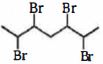
    The maximum number of stereoisomers that could exist for the compound below ?
    Nitration of benzene is a