MCQ
One mole of helium is adiabatically expanded from its initial state $\left(P_i, V_i, T_i\right)$ to its final state $\left(P_f, V_f, T_f\right)$. The decrease in the internal energy associated with this expansion is equal to
  • $C_V\left(T_i-T_f\right)$
  • B
    $C_P\left(T_i-T_f\right)$
  • C
    $\frac{1}{2}\left(C_P+C_V\right)\left(T i-T_f\right)$
  • D
    $\left(C_P-C_V\right)\left(T_i-T_f\right)$
Answer

Correct option: A.
$C_V\left(T_i-T_f\right)$
(a)$\Delta U=\mu C_V \Delta T=1 \times C_V\left(T_fT_i\right)=C_V\left(T_i-T_f\right) $

Need a full question paper?

Generate a complete, print-ready paper with questions like this in minutes — across 16+ boards, with answer keys.

Start Generating Free

Similar questions

A neutron having mass of $1.67 \times 10^{-27} \mathrm{~kg}$ and moving at $10^8 \mathrm{~m} / \mathrm{s}$ collides with a deutron at rest and sticks to it. If the mass of the deutron is $3.34 \times 10^{-27} \mathrm{~kg}$ then the speed of the combination is
The triode constant is out of the following
An engine develops $10 \mathrm{~kW}$ of power. How much time will it take to lift a mass of $200 \mathrm{~kg}$ to a height of $40 \mathrm{~m} .\left(g=10 \mathrm{~m} / \mathrm{sec}^2\right)$
The rate of flow of liquid in a tube of radius $r$, length $l$, whose ends are maintained at a pressure difference $P$ is $V=\frac{\pi Q P r^4}{\eta l}$ where $\eta$ is coefficient of the viscosity and $Q$ is
In a thermodynamics process, pressure of a fixed mass of a gas is changed in such a manner that the gas releases $20 \mathrm{~J}$ of heat and $8\ J$ of work is done on the gas. If the initial internal energy of the gas was $30 \%$. The final internal energy will be
What determines the hardness of the $X$-rays obtained from the Coolige tube
If temperature of an object is $140^{\circ} \mathrm{F}$, then its temperature in centigrade is
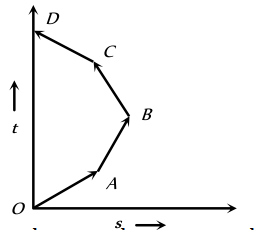
Which of the following options is correct for the object having a straight line motion represented by the following graph

Image

A moving coil galvanometer, having a resistance $G$, produces full scale deflection when a current $I_g$ flows through it. This galvanometer can be converted into $(i)$ an ammeter of range $0$ to $I_0 (I_0 > I_g)$ by connecting a shunt resistance $R_A$ to it and $(ii)$ into a voltmeter of range $0$ to $V(V = GI_0)$ by connecting a series resistance $R_V$ to it. Then,
A rod of length $l$ and radius $r$ is joined to a rod of length $l / 2$ and radius $r / 2$ of same material. The free end of small rod is fixed to a rigid base and the free end of larger rod is given a twist of $\theta^{\circ}$, the twist angle at the joint will be