MCQ
One serious drawback of semi$-$conductor devices is:
  • A
    They do not last for long time.
  • B
    They are costly.
  • They cannot be used with high voltage.
  • D
    They pollute the environment.

Answer

Correct option: C.
They cannot be used with high voltage.

Need a full question paper?

Generate a complete, print-ready paper with questions like this in minutes — across 16+ boards, with answer keys.
Start Generating Free

Similar questions

A rectangular coil (Dimension $5\,cm\times 2\,cm$ ) with $100\,turns,$ carrying a current of $3\,A$ in the clock-wise direction, is kept centered at the origin and in the $X-Z$ plane. A magnetic field of $1\,T$ is applied along $X-$ axis. If the coil is tilted through $45^o$ about $Z-$ axis, then the torque on the coil is.....$Nm$
The magnetic flux linked with a coil at any instant $‘t’$ is given by $\phi$ $= 5\,t^3 -100t + 300$, the $e.m.f$. induced in the coil at $t = 2$ second is.......$V$
A lens of large focal length and large aperture is best suited as an objective of an astronomical telescope since :
The mutual characteristic of triode is
The kinetic energy of an electron in $n^{th}$ orbit of unielectron species of atomic number $Z$ is $13.6\,\frac{{{z^2}}}{{{n^2}}}\,\,eV$ . The potential energy of this electron in the same orbit will be
When a certain photosensitive surface is illuminated with monochromatic light of frequency $v$ , the stopping potential for the photo current is $-V_0/2.$ When the surface is illuminated by monochromatic light of frequency $v/2,$ the stopping potential is $-V_0.$ The threshold frequency for photoelectric emission is
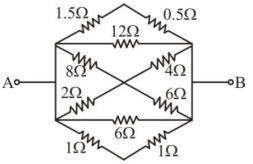
The equivalent resistance between $A$ and $B$ is $......$
A microwave of wavelength $2.0 \mathrm{~cm}$ falls normally on a slit of w1dth $4.0 \mathrm{~cm}$. The angular spread of the central maxima of the diffraction pattern obtained on a screen $1.5 \mathrm{~m}$ away from the slit, will be:
For small currents, $‘X’$ obeys Ohm’s law. But when large currents are passed through the same conductor, it deviates from ohmic behaviour. Identify $X.$
A caesium photocell, with a steady potential difference of 60V across, is illuminated by a bright point source of light 50 cm away. When the same light is placed 1m away the photoelectrons emitted from the cell