MCQ
Orbital angular momentum for a $d-$ electron is
  • A
    $\frac{{6h}}{{2\pi }}$
  • $\frac{{\sqrt 6 \,h}}{{2\pi }}$
  • C
    $\frac{{12h}}{{2\pi }}$
  • D
    $\frac{{\sqrt {12} \,h}}{{2\pi }}$

Answer

Correct option: B.
$\frac{{\sqrt 6 \,h}}{{2\pi }}$
b
(b) We know that for $d-$ electron $l = 2.$

$\mu = \sqrt {l(l + 1)} \,\frac{h}{{2\pi }}$; $\mu = \sqrt {2\,(2 + 1)} \,\frac{h}{{2\pi }}$

$\mu = \sqrt {2\,(2 + 1)} \frac{h}{{2\pi }}$; $\mu = \,\sqrt 6 \frac{h}{{2\pi }}.$

Need a full question paper?

Generate a complete, print-ready paper with questions like this in minutes — across 16+ boards, with answer keys.

Start Generating Free

Similar questions

The bonds between $P$ atoms and $Cl$ atoms in $PCl_5$ are likely to be
The heat of formation of methane $C(s) + 2{H_2}(g)\, \to \,C{H_4}(g)$ at constant pressure is $ 18500\, cal $ at ${25\,^o}C$. The heat of reaction at constant volume would be
The number of given statement/s which is/are correct is $.....$.

$(A)$ The stronger the temperature dependence of the rate constant, the higher is the activation energy.

$(B)$ If a reaction has zero activation energy, its rate is independent of temperature.

$(C)$ The stronger the temperature dependence of the rate constant, the smaller is the activation energy.

$(D)$ If there is no correlation between the temperature and the rate constant then it means that the reaction has negative activation energy.

$\begin{gathered}
  \begin{array}{*{20}{c}}
  {O\,\,\,\,\,\,\,\,\,\,\,\,\,\,\,\,\,\,\,\,\,\,\,\,\,\,\,\,\,\,\,\,\,\,\,\,\,\,\,\,\,\,\,\,\,\,\,\,\,\,\,\,\,\,\,\,\,\,\,\,\,\,\,\,\,\,\,\,\,\,\,\,\,\,} \\ 
  {||\,\,\,\,\,\,\,\,\,\,\,\,\,\,\,\,\,\,\,\,\,\,\,\,\,\,\,\,\,\,\,\,\,\,\,\,\,\,\,\,\,\,\,\,\,\,\,\,\,\,\,\,\,\,\,\,\,\,\,\,\,\,\,\,\,\,\,\,\,\,\,\,\,\,} \\ 
  {C{H_3} - {\text{  }}C - {\text{ }}O - H\xrightarrow{{NaH{{\mathop {CO}\limits^{14} }_3}}}\mathop {(A)}\limits_{(gas)} \xrightarrow[{(ii){H_3}{O^ \oplus }}]{{(i)PhMgBr}}(B)} 
\end{array} \hfill \\
  \begin{array}{*{20}{c}}
  {O\,\,\,\,\,\,\,\,\,\,\,\,\,\,\,\,\,\,\,\,\,\,\,\,\,\,\,\,\,\,\,\,\,\,\,\,\,\,\,\,\,\,\,\,\,\,\,\,\,\,\,\,\,\,\,\,\,\,\,\,\,\,\,\,\,\,\,\,\,\,\,\,\,\,} \\ 
  {||\,\,\,\,\,\,\,\,\,\,\,\,\,\,\,\,\,\,\,\,\,\,\,\,\,\,\,\,\,\,\,\,\,\,\,\,\,\,\,\,\,\,\,\,\,\,\,\,\,\,\,\,\,\,\,\,\,\,\,\,\,\,\,\,\,\,\,\,\,\,\,\,\,\,} \\ 
  {C{H_3} - S - O - H\xrightarrow{{NaH\mathop {C{O_3}}\limits^{14} }}\mathop {(C)}\limits_{(gas)} \xrightarrow[{(ii){H_3}{O^ \oplus }}]{{(i)PhMgBr}}(D)} \\ 
  {||\,\,\,\,\,\,\,\,\,\,\,\,\,\,\,\,\,\,\,\,\,\,\,\,\,\,\,\,\,\,\,\,\,\,\,\,\,\,\,\,\,\,\,\,\,\,\,\,\,\,\,\,\,\,\,\,\,\,\,\,\,\,\,\,\,\,\,\,\,\,\,\,\,\,\,} \\ 
  {O\,\,\,\,\,\,\,\,\,\,\,\,\,\,\,\,\,\,\,\,\,\,\,\,\,\,\,\,\,\,\,\,\,\,\,\,\,\,\,\,\,\,\,\,\,\,\,\,\,\,\,\,\,\,\,\,\,\,\,\,\,\,\,\,\,\,\,\,\,\,\,\,\,\,\,\,} 
\end{array} \hfill \\ 
\end{gathered}$

Product $(B)$ and $(D) $ in the above reaction are
The correct set of oxidation number of $N$ in $NH_4NO_2$ is
Which one has maximum oxidation number of phosphorous
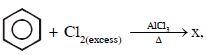
$x$ is 
Which one of the following species responds to an external magnetic field?
The ‘epimerisation’ involves
Identify $(B)$