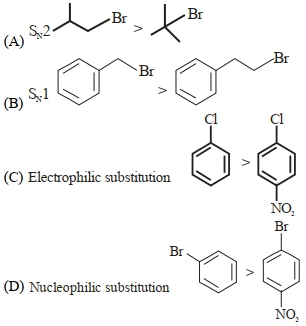
MCQ
Ortho-dihydroxy benzene is
- ACarvacrol
- BResorcinol
- ✓Catechol
- DOrcinol

Generate a complete, print-ready paper with questions like this in minutes — across 16+ boards, with answer keys.
$\begin{matrix}
\begin{matrix}
C{{H}_{3}}\,\,\,\,\,\,\,\, \,\, \\
|\,\,\,\,\,\,\,\,\,\,\,\,\,\,\,\,\,\, \\
\end{matrix} \\
C{{H}_{3}}-C-CH=C{{H}_{2}} \\
|\,\,\,\,\,\,\,\,\,\,\,\,\,\,\,\,\,\, \\
C{{H}_{3}}\,\,\,\,\,\,\,\, \,\,\,\, \\
\end{matrix}\,$ $\xrightarrow{{{H}_{2}}O/{{H}^{\oplus }}}$ $\underset{Major\,\,product}{\mathop{A}}\,$ $+$ $\underset{Major\,\,product}{\mathop{B}}\,$
The major product is
|
Exp. |
$[A]_0$ |
$[B]_0$ |
Initial rate |
|
$(1)$ |
$0.012$ |
$0.035$ |
$0.10$ |
|
$(2)$ |
$0.024$ |
$0.070$ |
$0.80$ |
|
$(3)$ |
$0.024$ |
$0.035$ |
$0.10$ |
|
$(4)$ |
$0.012$ |
$0.070$ |
$0.80$ |
$\mathop {(A)}\limits_{ gives\,\,positive ~\\ iodoform\,Test } \xrightarrow[\begin{subarray}{l} (ii)\,{H^ + },{H_2}O + ~\\ (iii)\,conc.\,{H_2}S{O_4}/\Delta \end{subarray} ]{{{\text{(i) C}}{{\text{H}}_{\text{3}}}{\text{MgBr}}}}(B)\xrightarrow{{{O_3}/Zn,{H_2}O}}$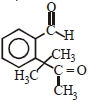
Statement $(I)$ : The $\mathrm{NH}_2$ group in Aniline is ortho and para directing and a powerful activating group.
Statement $(II)$ : Aniline does not undergo FriedelCraft's reaction (alkylation and acylation).
In the light of the above statements, choose the most appropriate answer from the options given below :
Choose the correct answer from the options given below: