MCQ
Orthophosphoric acid represents the molaysis condition due to
  • A
    Hydrogen bonding
  • Phosphorous group
  • C
    Maximum oxygen group
  • D
    Tribasicity

Answer

Correct option: B.
Phosphorous group
b
Orthophosphoric acid represents the molaysis condition due to Phosphorous group.

Need a full question paper?

Generate a complete, print-ready paper with questions like this in minutes — across 16+ boards, with answer keys.
Start Generating Free

Similar questions

Molar solution means $1\,mole$ of solute present in
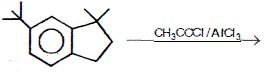
The major product of the reaction is
The correct option($s$) about entropy ($s$) is(are)

$[ R =$ gas constant, $F =$ Faraday constant, $T =$ Temperature $]$

$(A)$ For the reaction, $M (s)+2 H ^{+}(a q) \rightarrow H _2(g)+ M ^{2+}(a q)$, if $\frac{ dE _{c o l l}}{ dT }=\frac{ R }{ F }$, then the entropy change of the reaction is $R$ (assume that entropy and internal energy changes are temperature independent).

$(B)$ The cell reaction, $Pt (s) \mid H _2(g, 1$ bar $)\left| H ^{+}(a q, 0.01 M ) \| H ^{+}(a q, 0.1 M )\right| H _2(g, 1 bar ) \mid Pt (s)$, is an entropy driven process.

$(C)$ For racemization of an optically active compound, $\Delta S >0$.

$(D)$ $\Delta S >0$, for $\left[ Ni \left( H _2 O \right)_6\right]^{2+}+3$ en $\rightarrow\left[ Ni ( en )_3\right]^{2+}+6 H _2 O$ (where en $=$ ethylenediamine).

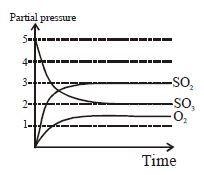
The dissociation of $SO_3(g)$ into $SO_2(g)$ & $O_2(g)$ is carried out in a closed container at a constant temperature $T$ . The equilibrium constant for the reaction is $K_P$ = $x\  atm^2$ . The partial pressure variation for the three gases is as shown 

The value of $x$ is

The $IUPAC$ name of $\begin{array}{*{20}{c}}
  {C{H_2}C{H_3}\,\,\,C{H_3}\,\,\,\,\,\,\,\,\,\,\,\,\,\,\,\,\,\,\,\,\,\,\,\,\,\,\,} \\ 
  {|\,\,\,\,\,\,\,\,\,\,\,\,\,\,\,\,|\,\,\,\,\,\,\,\,\,\,\,\,\,\,\,\,\,\,\,\,\,\,\,\,\,\,} \\ 
  {C{H_3} - C{H_2} - C - CH - C{H_2} - {{(C{H_2})}_2} - C{H_3}} \\ 
  {|\,\,\,\,\,\,\,\,\,\,\,\,\,\,\,\,\,\,\,\,\,\,\,\,\,\,\,\,\,\,\,\,\,\,\,\,\,\,\,\,\,\,\,} \\ 
  {\,\,\,\,C{H_2}C{H_{3\,\,\,\,\,\,\,\,\,\,\,\,\,\,\,\,\,\,\,\,\,\,\,\,\,\,\,\,\,\,\,\,\,\,\,\,\,\,\,\,\,\,\,\,\,\,\,\,\,\,\,\,\,\,}}} 
\end{array}$ is
The quantity of silver deposited when one coulomb charge is passed through $\ce{AgNO_3}$ solution:
The hydrogen electrode is dipped in a solution of $\mathrm{pH}=3$ at $25^{\circ} \mathrm{C}$. The potential of the electrode will be_________ $\times 10^{-2} \mathrm{~V}$.$\left(\frac{2.303 \mathrm{RT}}{\mathrm{F}}=0.059 \mathrm{~V}\right)$
The ionisation energy of a certain element is $1540\ kJ\ mol^{-1}$ . When the atoms of this element are in the first excited state, the ionisation energy is only $300\ kJ\ mol^{-1}$ . The region of the electromagnetic wave spectrum in which the light is emitted in a transition from the first excited state to the ground state.
The $IUPAC$ name of 

$\begin{array}{*{20}{c}}
  {\,\,\,\,\,\,\,\,\,\,\,\,\,\,\,\,\,\,\,\,\,\,\,\,\,\,\,\,\,\,\,\,\,\,\,\,\,\,\,\,C{H_3}} \\ 
  {\,\,\,\,\,\,\,\,\,\,\,\,\,\,\,\,\,\,\,\,\,\,\,\,\,\,\,\,\,\,\,\,\,\,\,|} \\ 
  {C{H_3} - CH - C{H_2} - C - C{H_3}} \\ 
  {\,\,\,|\,\,\,\,\,\,\,\,\,\,\,\,\,\,\,\,\,\,\,\,\,\,\,\,\,\,\,\,\,\,\,\,|} \\ 
  {\,\,\,\,\,\,\,OH\,\,\,\,\,\,\,\,\,\,\,\,\,\,\,\,\,\,\,\,\,\,\,\,\,\,OH\,} 
\end{array}$ and $\begin{array}{*{20}{c}}
  {C{H_2} - CH - C{H_2}} \\ 
  {|\,\,\,\,\,\,\,\,\,\,\,\,\,\,|\,\,\,\,\,\,\,\,\,\,\,\,\,\,|\,\,\,\,\,} \\ 
  {CN\,\,\,\,\,\,\,\,CN\,\,\,\,\,\,\,\,CN\,\,} 
\end{array}$

${{C_6}{H_5}CHO + HCN \to }$ $\begin{matrix}
  \,\,\,\, H  \\
\,\,\,\,   |\\
   {{C}_{6}}{{H}_{5}}-C-CN  \\
  \,\,\,\, |  \\
   \,\,\,\,\,\,OH \\
\end{matrix}$ The product would be