Question
Our resources cannot keep pace with the rising population. Give three examples in support of this statement.

Answer

(i) Food: The first and most important need of the humans (or any living organism) is food. But with the production of food rising by arithmetic progression and population growing by geometric progression i.e. the number at each step is being multiplied. At the same time growing population is increasing the use of more and more agricultural land to build houses. Thus it is evident that food would be running short for the unchecked rising population.
(ii) Water: Availability of clean and germ-free water for drinking purposes would be more and more scarce with increase in population; the reason would be mainly, the pollution of rivers, ponds, lakes etc.
(iii) Land: Man is bringing more and more land under cultivation and also using up land for building more residential colonies, factories and industries. Usable land would thus become less and less available.
Need a full question paper?

Generate a complete, print-ready paper with questions like this in minutes — across 16+ boards, with answer keys.

Start Generating Free

Similar questions

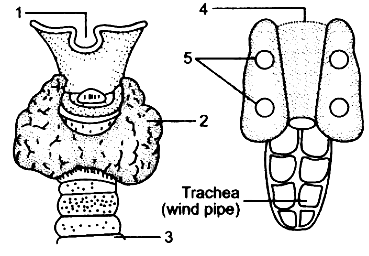
Given alongside are the diagrammatic sketches of some endocrine glands. Observe the figures and answer the following questions:
(i) Label the parts numbered 1 to 5.
(ii) Name the hormones secreted by (2) and (5).
(iii) Which chemicals in our body are greatly affected by hormones?
(iv) What is the chemical nature of hormones?
(v) Name the elements related to the functioning of hormones secreted by the structure (2) and (5).
List some adaptations found in desert plants to reduce transpiration.
Write the short note on:
WHO
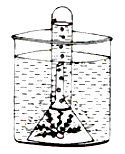
An experiment was set up as shown in the figure alongside. Look at the figure and answer the following questions:
( i) What is the objective of this experiment?
( ii ) Which plant is used in this experiment?
( iii ) Which gas is evolved in this process?
( iv ) What will happen to the rate of evolution of this gas if a pinch of sodium
bicarbonate is added?
(v ) What will happen if the apparatus is kept in dark?
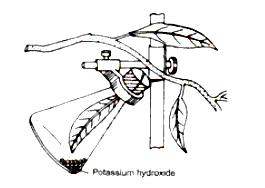
An experiment was set up as shown in the figure given below . The twig in the diagram was intact on the plant and it was as such in sunlight for a few hours .

(i) What is the aim of the above experiment ?
(ii) Why was potassium hydroxide placed inside the conical flask ?
(iii) What test would you perform on the leaf inside the flask?
(iv) What is the expected result of the above test ?
(v) Is it necessary to similarly test on outer leaf also ? Giva a reason .
Make a punnett square for finding out the proportion of different genotypes in the progeny of a genetic cross between.
A pure tall (TT) pea plant with a pure dwarf (tt) pea plant.
A healthy croton plant bearing variegated leaves was kept in a dark cupboard to destarch it after which it was placed in sunlight for a few hours. One of the leaves was then plucked and an outline of the leaf marking the green and the non-green regions was drawn. The leaf was then tested for starch. Using the above information, answer the following questions:
  1. State the aim of the above experiment.
  2. Name the chemical used for testing the presence of starch.
  3. Why is the leaf boiled in water and alcohol before testing for the presence of starch?
  4. What change is seen on the leaf after the starch test?
  5. Give the chemical equation to represent the process of starch formation in plants.
Explain briefly the relationship between poverty and population and how one affects the other.
State the three mendel’s laws of inheritance.