MCQ
Out of following four dimensional quantities, which one quantity is to be called a dimensional constant
  • A
    Acceleration due to gravity
  • B
    Surface tension of water
  • C
    Weight of a standard kilogram mass
  • The velocity of light in vacuum

Answer

Correct option: D.
The velocity of light in vacuum
d
Acceluation dueto gravity changelas we move on surface of earth.

Swrface tension of water varies with temperetore. standard kgis defined mannally. Velocity of light is constant $3 \times 10^{8 . m / s }$.

Need a full question paper?

Generate a complete, print-ready paper with questions like this in minutes — across 16+ boards, with answer keys.
Start Generating Free

Similar questions

Two spherical balls having equal masses with radius of $5\, {cm}$ each are thrown upwards along the same vertical direction at an interval of $3\, {s}$ with the same initial velocity of $35 \,{m} / {s}$, then these balls collide at a height of $\ldots \ldots \ldots . {m}$. (Take ${g}=10 \,{m} / {s}^{2}$ )
During an adiabatic process, the pressure of a gas is found to be proportional to the cube of its absolute temperature. The ratio $\frac{\text{C}_\text{P}}{\text{C}_\text{V}}$ for gas is:
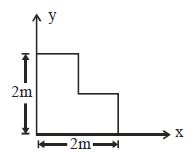
The $x, y$ coordinates of the centre of mass of a uniform $L-$ shaped lamina of mass $3\, kg$ is
An increases in pressure required to decreases the $200$ litres volume of a liquid by $0.004\%$ in container is .......... $kPa$ (Bulk modulus of the liquid $= 2100\, MPa$)
A gas follows $VT^2 =$ constant. The coefficient of volume expansion of the gas is
Particles of masses $m, 2m, 3m,......nm$ $grams$ are placed on the same line at distances $l, 2l, 3l,....nl\, cm$ from a fixed point. The distance of centre of mass of the particles from the fixed point in centimetres is
The height at which the weight of a body  becomes ${\frac{1}{16}}^{th}$ , its weight on the surface of earth (radius $R$), is
Two spheres of same size one of mass $2\ kg$ and another of mass $4\ kg$ are dropped simultaneously from the top of Qutab Minar $($height $= 72m)$. When they are $1m$ above the ground, the two spheres have the same:
A particle doing simple harmonic motion, amplitude $= 4\ cm,$ time period $= 12\sec.$ Ratio of time taken by it in going from its mean position to $2\ cm$ and from $2\ cm$ to extreme position is:
Which one of the following statements is true for the speed $v$ and the acceleration $a$ of a particle executing simple harmonic motion