Question
Outcrossing and Crossbreeding.

Answer

OutcrossingCrossbreeding
1. Breeding of animals of the same breed but having no common ancestors for 4 to 6 generations is known as outcrossing.1. Breeding of superior male of one breed with superior female of another breed is known as crossbreeding.
2. Progeny is known as outeross. 2. Progeny is known as hybrid.
3. New breeds are not developed by outcrossing.3. New breeds or hybrids are formed by crossbreeding.
4. An outcross helps to overcome inbreeding depression.4. Hybrids are subjected to inbreeding and new stable breeds are developed by crossbreeding.

Need a full question paper?

Generate a complete, print-ready paper with questions like this in minutes — across 16+ boards, with answer keys.

Start Generating Free

Similar questions

Disease Vector species
(a) Dengue(i) Anopheles
(b) Malaria(ii) Housefly
(c) Filaria(iii) Culex
(d) Typhoid(iv) Aedes
Distinguish between: Allopatric and Sympatric speciation.
Respiratory capacitiesRespiratory volumes
(1) Residual volume (RV)(a) 500 ml
(2) Vital capacity (VC)(b) 2000 – 3000 ml
(3) Tidal volume (TV)(c) 1100 – 1200 ml
(4) Inspiratory reserve volume (IRV)(d) 4100 – 4600 ml
Read the following and answer any four questions from (i) to (v) given below:
ln a plant species that follows Mendelian inheritance yellow flower colour is dominant over white and round fruits shape is dominant over elongated. Crossing was performed between two purelines-one having yellow-flower and round fruit and another with white flower and elongated fruits. About 20 plants survived in $F_1$ progeny. Plants of $F_1$ were allowed to self fertilise and about 960 plants survived in $F_2$
  1. How many plants would have yellow flower and round fruit in $F_1$ generation?
  1. 20
  2. 10
  3. 5
  4. 0
  1. How many plants would have yellow flower and round fruit in $F_2$​​​​​​​ generation?
  1. 960
  2. 540
  3. 180
  4. 60
  1. Which of the following is correct for the condition when plant heterozygous for yellow flower and round fruit is back crossed with the double recessive parent?
  1. 9 : 3 : 3 : 1 ratio of phenotype only.
  2. 9 : 3 : 3 : 1 ratio of genotype only.
  3. 1 : 1 : 1 : 1 ratio of phenotype only.
  4. 1 : 1 : 1 : 1 ratio of phenotype and genotype.
  1. When the plant heterozygous for yellow flower and round fruit are self crossed, then the plant with yellow flower and elongated fruit will be represented by the genotype?
  1. YyRr, YyRR, YYRr
  2. Yyrr, YYrr, yyrr
  3. yyRr, yyRR
  4. Yyrr, YYrr
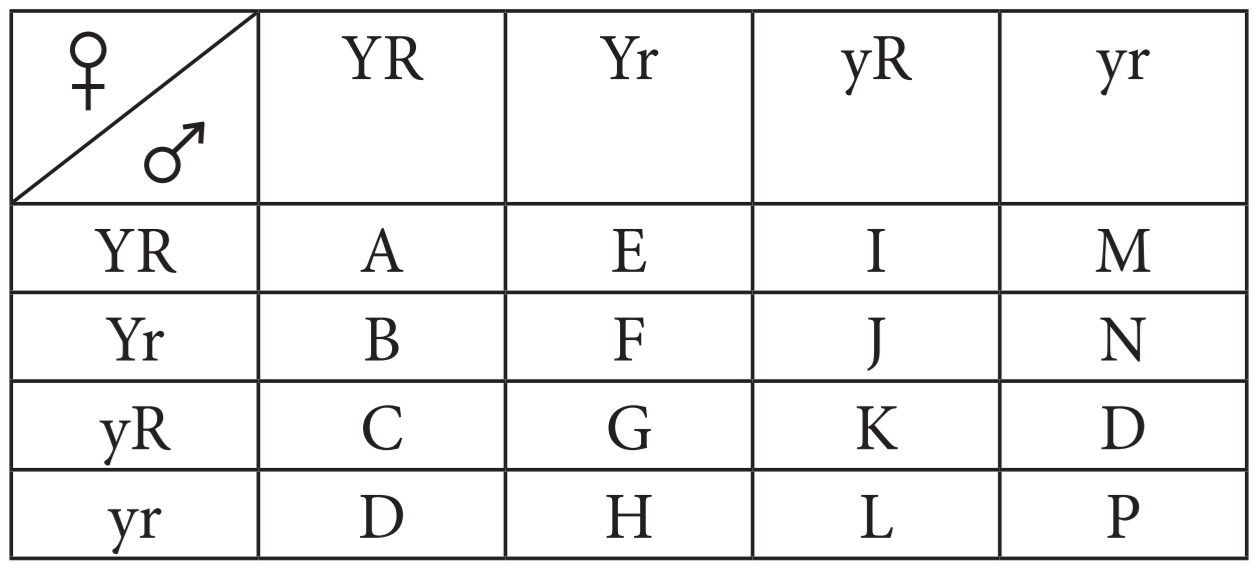
  1. 'Tile given Punnett's square represents the pattern of inheritance in a dihybrid cross where yellow flower and round fruit (R) condition is dominant over white flower (y) and elongated fruit (r) condition.


Plant 'C' will produce fruits with the genotype identical to fruits produced by the plant of
  1. type H
  2. type E
  3. type K
  4. type 1
Read the following and answer any four questions from (i) to (v) given below:
Turner's syndrome is an example of monosomy. It is formed by the union of an allosome free egg and a normal 'X' containing sperm or a normal egg and an allosome free sperm. 'The individual has 2n = 45 chromosomes (44 + X0) instead of 46. Such individuals are sterile females who have rudimentary ovaries, under developed breasts, small uterus, short stature, webbed neck and abnormal intelligence. 'They may not menstruate or ovulate. This disorder can be treated by giving female sex hormone to the women from the age of puberty to make them develop breasts and have menstruation. This makes them feel more normal.
  1. Number of barr body present in a female with Turner's syndrome is?
  1. 0
  2. 1
  3. 2
  4. < 2.
  1. Turner's syndrome is an example of?
  1. Aneuploidy.
  2. Euploidy.
  3. Polyploidy.
  4. Autosomal abnormality.
  1. Turner's syndrome is a/an.
  1. Autosomal recessive Mendelian disorder.
  2. Autosomal dominant Mendelian disorder
  3. Sex linked Mendelian disorder.
  4. Chromosomal disorder.
  1. Which of the following statements regarding Turner's syndrome is incorrect?
  1. It is a case of monosomy of chromosomes.
  2. The suffering individual is a sterile female, having one 'X' chromosome missing in the cells.
  3. The problem is due to an extra chromosome.
  4. The individual are of short stature.
  1. Assertion: Turner's syndrome is caused due to absence of any one of the X and Y sex chromosome.
Reason: Individuals suffering from Turner's syndrome show masculine as well as feminine development
  1. Both assertion and reason are true and reason is the correct explanation of assertion.
  2. Both assertion and reason are true but reason is not the correct explanation of assertion.
  3. Assertion is true but reason is false.
  4. Both assertion and reason are false.
Read the following and answer any four questions from (i) to (v) given below:
Haemophilia is a sex linked disease which is also known as bleeder's disease as the patient will continue to bleed even from a minor cut since he or she does not possess the natural phenomenon of blood clotting due to absence of anti -haemophilic globulin or factor VIII and plasma thromboplastin factor IX essential for it. As a result of continuous bleeding the patient may die of blood loss. Colour blindness is another type of sex linked trait in which the eye fails to distinguish red and green colours. Vision is however, not affected and the colour blind can, lead a normal life, reading, writing and driving (distinguishing traffic lights by their position).
  1. If a haemophilic man marries a woman whose father was haemcphihc and mother was normal then which of the following holds true for their progenies?
  1. Of the total number of daughters, 50% daughters are carrier and $50 \%$ are haemophilic.
  2. All the daughters are haemophilic.
  3. All sons are haemophilic and all daughters are normal.
  4. All sons are normal, all daughters are carriers.
  1. A man whose father was colourblind and mother was normal marries a woman whose father was haemophilic and mother was normal. Which of the following is true for their progenies? [Note: Percentage is from the total number of progenies]
  1. $25 \%$ female progenies carry the gene for both haemophilia and colourblindness.
  2. $25 \%$ male progenies carry only the gene of colourblindness.
  3. $25 \%$ female progenies carry only the gene of colourblindness.
  4. $25 \%$ male progenies and 25% female progenies carry the gene of haemophilia.
  1. Which of the following statements is incorrect regarding haemophilia?
  1. It is a dominant disease.
  2. A single protein involved in clotting of blood is affected.
  3. It is recessive disease.
  4. It is Mendelian disorder.
  1. Anup is having colourblindness and is married to Soni who is normal. What is the chance that their son will have the disease?
  1. $100 \%$
  2. $50 \%$
  3. $25 \%$
  4. $0 \%$
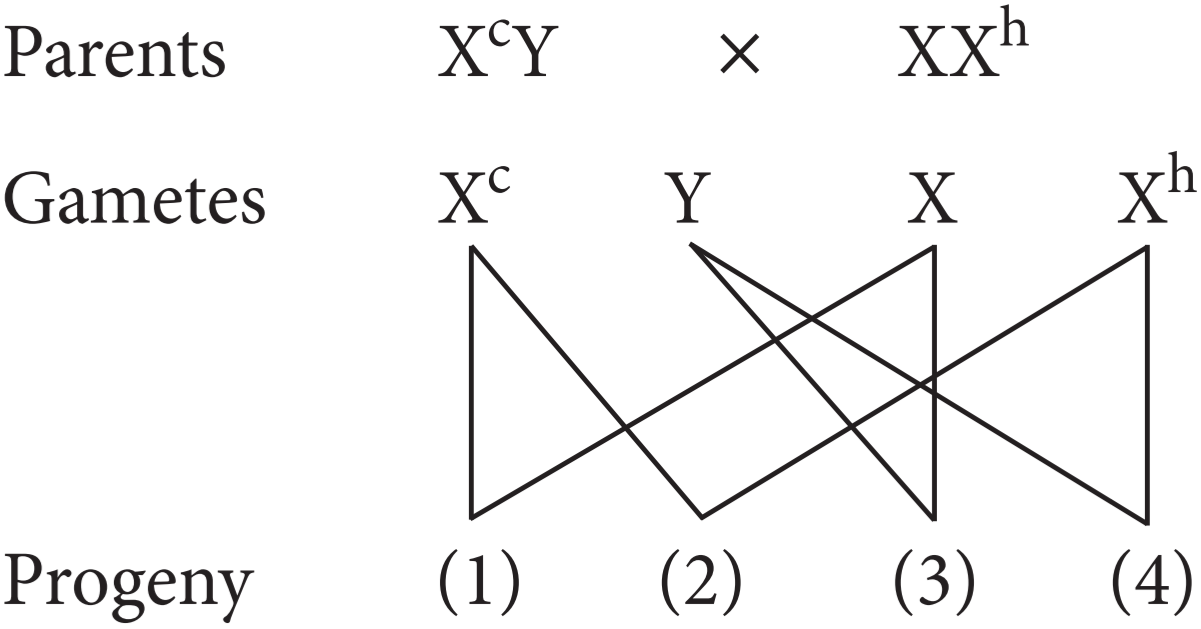
  1. Refer to the given cross?


Select the correct option regarding $1, 2, 3$ and $4$.
  1. The options are as follow:
  1. Colourblind carrier female.
  2. Colourblind haemophilic female.
  3. Normal male.
  4. Haemophilic male
  1. The options are as follow:
  1. Colourblind people
  2. Haemophilic female.
  3. Normal male
  4. Haemophilic male
  1. The options are as follow:
  1. Colourblind female
  2. Colourblind and haemophilic female
  3. Normal male
  4. Normal male.
  1. The options are as follow:
  1. Colourblind carrier female.
  2. Normal female.
  3. Normal male.
  4. Haemophilic male.
Distinguish between : Epithalamus and hypothalamus.
Water body ASalinity values B
(1) Streams(a) 340 ppt
(2) Indian Ocean(b) 5 ppt
(3) Hyper saline lagoon(c) 30-35 ppt
(4) Dead sea(d) 100 ppt
Distinguish between : Genetic diversity and Species diversity.
Read the following and answer any four questions from (i) to (v) given below:
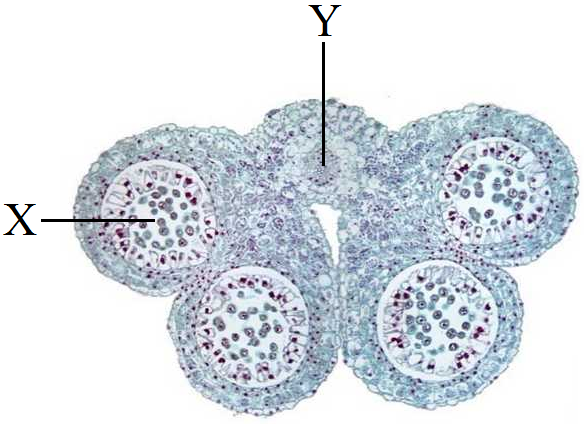
Many adaptations are found in flowers to achieve certain kind of pollination. The pollination achieved by insects is known as entomophily. The given diagram shows the cross-section of an anther of an insect pollinated flower.
  1. Which of the following is/ are the function(s) of structure Y?
  1. To carry waste products away from the anther.
  2. To supply oxygen to the cells of the anther.
  3. To transport food and mineral salts to the anther.
  4. To supply water to the anther.
  1. Conly.
  2. C and D only.
  3. A, B and D only.
  4. A, B, C and D.
  1. Which of the following most accurately describes the structures found in compartment X?
  1. They contain two haploid nuclei resulting from meiosis.
  2. They contain two haploid nuclei resulting from mitosis.
  3. They contain two haploid male gametes, resulting from mitosis.
  4. They contain a vegetative nucleus and pollen tube nucleus.
  1. Which of the following is a distinctive characteristic of insect-pollinated flower?
  1. All of them have nectar guides on their flowers.
  2. They produce sugary fruit.
  3. Their pollen grains tend to have rough surfaces.
  4. They produce abundant quantities of pollen to make up for pollen grains that might be removed by the wind.
  1. Which of the following are likely characteristics of the structures found in X and stamens of this plant?
S. No
Structure of X
Stamens
(a)
Abundant and light
Pendulous
(b)
Rough surfaces
Non-pendulous
(c)
Light and sticky
Pendulous
(d)
Coarse and sticky
Protrude outside the flower
  1. Spiny or sticky pollen grains and large, attractively coloured flowers are associated with:
  1. Hydrophily.
  2. Entomophily.
  3. Ornithophily.
  4. Anemophily.