Question
Outside a nucleus

Answer

(c)Out side the Nucleus, neutron is unstable (life $\approx$ $932\, sec$)

Need a full question paper?

Generate a complete, print-ready paper with questions like this in minutes — across 16+ boards, with answer keys.
Start Generating Free

Similar questions

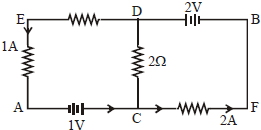
In the circuit, given in the figure currents in different branches and value of one resistor are shown. Then potential at point $B$ with respect to the point $A$ is$.......V$
A series $LCR$ circuit of $R=5\, \Omega, L=20\, {mH}$ and ${C}=0.5 \,\mu \,{F}$ is connected across an ${AC}$ supply of $250\, V$, having variable frequency. The power dissipated at resonance condition is $.....\,\times 10^{2}\, {W}$
A galvanometer of resistance $25\,\Omega $ gives full scale deflection for a current of $10$ milliampere, is to be changed into a voltmeter of range $100\, V$ by connecting a resistance of $‘R’$ in series with galvanometer. The value of resistance $R$ in $\Omega $ is
Consider the following statements regarding the photoelectric eff ect experiment:

$(I)$ Photoelectrons are emitted as soon as the metal is exposed to light.

$(II)$ There is a minimum frequency below which no photo-current is observed.

$(III)$ The stopping potential is proportional to the frequency of light.

$(IV)$ The photo-current varies linearly with the intensity of the light.

Which of the above statements indicate that light consists of quanta (photons) with energy proportional to frequency?

If there is an error of $1\%$ in calculation of mass of disc and $1.5\%$ error in radius, then $\%$ error in moment of inertia about an axis tangent to disc is  .......... $\%$
A constant volume gas thermometer shows pressure reading of $50 \,cm$ and $90 \,cm$ of mercury at $0^{\circ} C$ and $100^{\circ} C$ respectively. When the pressure reading is $60 \,cm$ of mercury, the temperature is ......... $^{\circ} C$
Two satellites of masses ${m_1}$ and ${m_2}({m_1} > {m_2})$ are revolving round the earth in circular orbits of radius ${r_1}$ and ${r_2}({r_1} > {r_2})$ respectively. Which of the following statements is true regarding their speeds ${v_1}$ and ${v_2}$ ?
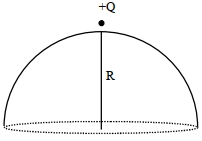
A point charge $+Q$ is placed just outside an imaginary hemispherical surface of radius $R$ as shown in the figure. Which of the following statements is/are correct?

(IMAGE)

$[A]$ The electric flux passing through the curved surface of the hemisphere is $-\frac{\mathrm{Q}}{2 \varepsilon_0}\left(1-\frac{1}{\sqrt{2}}\right)$

$[B]$ Total flux through the curved and the flat surfaces is $\frac{Q}{\varepsilon_0}$

$[C]$ The component of the electric field normal to the flat surface is constant over the surface

$[D]$ The circumference of the flat surface is an equipotential
Energy needed in breaking a drop of radius $R$ into $n$ drops of radii $ r$ is given by
The magnetic force acting on a charged particle of charge $-2\, \mu  C$ in a magnetic field of $2\, T$ acting in $y$ direction, when the particle velocity is $(2i + 3 j) \times  10^6\,\, m/s$ is