MCQ
Oxygen boils at $-183°C.$ This temperature is approximately ....... $^oF$
  • A
    $215$
  • $-297$
  • C
    $329$
  • D
    $361$

Answer

Correct option: B.
$-297$
b
(b) $\frac{C}{5} = \frac{{F - 32}}{9}$ $\Rightarrow$ $\frac{{ - 183}}{5} = \frac{{F - 32}}{9}$ $\Rightarrow$ $F = - 297^\circ F$

Need a full question paper?

Generate a complete, print-ready paper with questions like this in minutes — across 16+ boards, with answer keys.

Start Generating Free

Similar questions

A jet of liquid of cross-sectional area $'a'$ strikes a wall making angle $\theta $ with wall. The water strikes with the wall with velocity $v$ and rebounds elastically. If density of liquid be $\rho $, the normal force on the wall is
The internal energy of 2 moles of a mono atomic gas is:
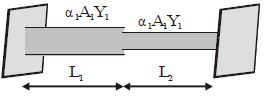
Two rods are joined between fixed supports as shown in the figure. Condition for no change in the lengths of individual rods with the increase of temperature will be

( ${\alpha _1},\,{\alpha _2},$ = linear expansion coefficient

$A_1, A_2$ = Area of rods

$Y_1, Y_2$ = Young modulus)
A particle is fastened at the end of a string and is whirled in a vertical circle with the other end of the string being fixed. The motion of the particle is:
  1. Periodic.
  2. Oscillatory.
  3. Simple harmonic.
  4. Angular simple harmonic.
If density of a planet is double that of the earth and the radius $1.5$ times that of the earth, the acceleration due to gravity on the surface of the planet is ........
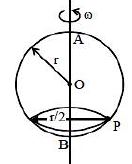
A smooth wire of length $2\pi r$ is bent into a circle and kept in a vertical plane. A bead can slide smoothly on the wire. When the circle is rotating with angular speed $\omega$ about the vertical diameter $AB$, as shown in figure, the bead is at rest with respect to the circular ring at position $P$ as shown. Then the value of $\omega^2$ is equal to
A body takes $T$ minutes to cool from ${62^o}C$ to ${61^o}C$ when the surrounding temperature is ${30^o}C$. The time taken by the body to cool from ${70^o}$ to $({A_1}\,{\rm{and }}{A_{\rm{2}}})$ is
What are the dimensions of the change in velocity?
$A$ weightless rod is acted on by upward parallel forces of $2N$ and $4N$ ends $A$ and $B$ respectively. The total length of the rod $AB = 3m$. To keep the rod in equilibrium a force of $6N$ should act in the following manner:
A bimetallic strip is formed out of two identical strips, one of copper and other of brass. The coefficients of linear expansion of the two metals are ${\alpha _C}$ and ${\alpha _{B}}.$ On heating, the temperature of the strip goes up by $\Delta T$ and the strip bends to form an arc of radius of curvature $R.$ Then $R$ is