MCQ
$p-n$ junction diode acts as:
  • A
    ohmic resistance
  • non$-$ohmic resistance
  • C
    both $A$ and $B$
  • D
    amplifier

Answer

Correct option: B.
non$-$ohmic resistance
We know that in the case of metallic conductors, the potential difference varies in direct proportion to the current flowing. The $I−V$ graph of a ohmic conductor is a straight line. But, a $p-n$ junction diode is not in according with Ohm's law. The current voltage characteristic curve of a $p-n$ junction diode shows both forward bias as well as reverse bias characteristics as shown as in the graph.

Need a full question paper?

Generate a complete, print-ready paper with questions like this in minutes — across 16+ boards, with answer keys.
Start Generating Free

Similar questions

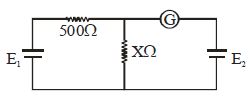
In the adjoining circuit, the battery $E_1$ has an emf of $12\, volt$ and zero internal resistance while the battery $E_2$ has an $emf$ of $2\, volt$. If the galvanometer $G$ reads zero, then the value of the resistance $X$ (in $ohm$ ) is
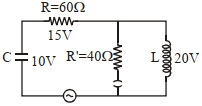
The angular frequency of alternating current in a $L-C-R$ circuit is $100\, rad / s$. The components connected are shown in the figure. Find the value of inductance of the coil and capacity of condenser.
The drift velocity does not depend upon
Which of the following particles are constituents of the nucleus
Which of the following phenomena can be demonstrated by light, but not with sound waves in an air column?
A driving mirror consists of a cylindrical mirror of radius of curvature $10 \,cm$ and the length over the curved surface is $10 \,cm$. If the eye of the driver be assumed to be at a great distance from the mirror, then field of view in radian is
A charged body has an electric flux $F$ associated with it. Now if the body is place inside a conducting shell then the electric flux outside the shell is:
When the energy of the incident radiation is increased by $20\%$, the kinetic energy of the photoelectrons emitted from a metal surface increased from $0.5eV$ to $0.8eV$. The work function of the metal is?
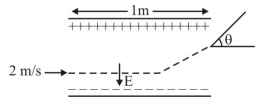
A uniform electric field $E =(8\,m / e ) V / m$ is created between two parallel plates of length $1 m$ as shown in figure, (where $m =$ mass of electron and $e=$ charge of electron). An electron enters the field symmetrically between the plates with a speed of $2\,m / s$. The angle of the deviation $(\theta)$ of the path of the electron as it comes out of the field will be........
An uncharged parallel plate capacitor having a dielectric of constant $K$ is connected to a similar air-cored parallel capacitor charged to a potential $V$. The two share the charge and the common potential is $V'$. The dielectric constant $K$ is