MCQ
Pair of metals which does not dissolve in nitric acid
  • $Cr, Al$
  • B
    $Al, Ag$
  • C
    $Ag, Au$
  • D
    $Pt, Hg$

Answer

Correct option: A.
$Cr, Al$
a
chromium and aluminium do not dissolve in concentrated nitric acid because of the formation of a passive form of oxide on the surface.

Need a full question paper?

Generate a complete, print-ready paper with questions like this in minutes — across 16+ boards, with answer keys.

Start Generating Free

Similar questions

Calculate the molecular weight of a substance whose $7.0\%$ by mass solution in water freezes at $-0.93\,^oC$ . The cryoscopic constant of water is $1.86\,^oC\,kg\,molal^{-1}$ ........... $g\,mol^{-1}$.
A standard hydrogen electrode has zero electrode potential because
Match List $I$ with $II$ and pick the correct matching from the codes given below
  List $I$ (Haloalkane/arene)   Lits $II$ (Application)
$A.$ Iodoform $1.$ $CF_4$
$B.$ $BHC$ $2.$ Antiseptic
$C.$ Freon $-14$ $3.$ Moth repellent
$D.$ Halothanes $4.$ Inhalative anaesthetic
$E.$ $p-$ Dichlorobenzene $5.$ Termite pesticide
At high pressure the following reaction is zero order:

$2N{H_3}(g)\xrightarrow[{Pt\,catalyst}]{{1130\,K}}{N_2}(g) + 3{H_2}(g)$

Choose the option which is not true with respect to the reaction, from the choices given below :-
Find out $Ka$ for acid when degree of hydrolysis of $0.1\, M\, CH_3COONa$ is $1\%$
Which one of the following compounds gives acetone $(CH_3)_2 C = O$ as one of  the product of its ozonolysis ?
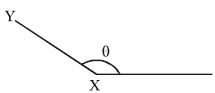
Which bond angle $\theta $ would result in the maximum dipole moment for triatomic molecule $XY_2$ shown below
The petrol having octane number $80$ has
Examine the following statements pertaining to an ${S_{{N^2}}}$ reaction

(1)The rate of reaction is independent of the concentration of the nucleophile

(2)The nucleophile attacks the ${C^ - }$ atom on the side of the molecule opposite to the group being displaced

(3)The reaction proceeds with simultaneous bond formation and bond rupture/ cleavage

Amongst the following which of the above were true

A certain buffer solution contains equal concentration of $X^-$ and $HX$. The $K_b$ for $X^-$ is $10^{-10}$. The $pH$ of the buffer is