MCQ
particle is dropped from a height and another particle is thrown in horizontal direction with speed of $5 m / sec$ from the same height. The correct statement is
  • Both particles will reach at ground simultaneously
  • B
    Both particles will reach at ground with same speed
  • C
    Particle $$ will reach at ground first with respect to particle
  • D
    Particle will reach at ground first with respect to partical
Answer

Correct option: A.
Both particles will reach at ground simultaneously
(a) For both cases $t=\sqrt{\frac{2 h}{g}}=$ constant.Because vertical downward component of velocity will be zero for both the particles.

Need a full question paper?

Generate a complete, print-ready paper with questions like this in minutes — across 16+ boards, with answer keys.

Start Generating Free

Similar questions

A small body of mass $0.10 kg$ is executing S.H.M. of amplitude $1.0 m$ and period $0.20 sec$. The maximum force acting on it is
The intensity of direct sunlight on a surface normal to the rays is $I_0$. What is the intensity of direct sunlight on a surface, whose normal makes an angle of 60 with the rays of the sun
If the current is halved in a coil, then the energy stored is how much times the previous value
A tube closed at one end and containing air is excited. It produces the fundamental note of frequency $512 \mathrm{~Hz}$. If the same tube is open at both the ends the fundamental frequency that can be produced is
What is the velocity of the bob of a simple pendulum at its mean position, if it is able to rise to vertical height of $10 \mathrm{~cm}$ (Take $\left.g=9.8 \mathrm{~m} / \mathrm{s}^2\right)$
Image
In Millikan's experiment for the determination of the charge on the electron, the reason for using the oil is
A particle $P$ moving with speed $v$ undergoes a head -on elastic collision with another particle $Q$ of identical mass but at rest. After the collision
Four smooth steel balls of equal mass at rest are free to move along a straight line without friction. The first ball is given a velocity of $0.4 \mathrm{~m} / \mathrm{s}$. It collides head on with the second elastically, the second one similarly with the third and so on. The velocity of the last ball is
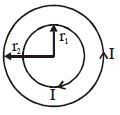
Two circular concentric loops of radii $r_1 = 20\,cm$ and $r_2 = 30\,cm$ are placed in the $X, Y-$ plane as shown in the figure. A current $I = 7\,amp$ is flowing through them. The magnetic moment of this loop system is
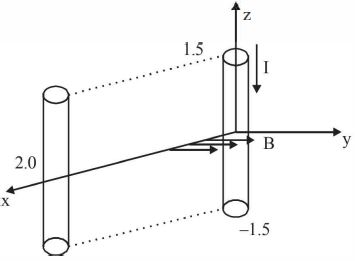
A conductor lies along the $z-$axis $a$ $-1.5$$ \le Z < 1.5\,m$ carries a fixed current of $10.0\ A$ in $ - {\hat a_z}$ direction (see figure). For a field $\vec B$ $=$ $3.0 \times  10^{-4}$  $e^{-0.2x}$ ${\hat a_y}\,T$ find the power required to move the conductor at constant speed to $x = 2.0\ m, y = 0\ m$ in $5 \times 10^{-3}\ s$. Assume parallel motion along the $x-$axis........$ W$