MCQ
Particles having positive charges occasionally come with high velocity from the sky towards the earth. On account of the magnetic field of earth, they would be deflected towards the
  • A
    North
  • B
    South
  • East
  • D
    West

Answer

Correct option: C.
East
c
(c)East, (By $\overrightarrow F = q(\overrightarrow {v\,} \times \overrightarrow B )$) or by applying Fleming's left hand rule.

Need a full question paper?

Generate a complete, print-ready paper with questions like this in minutes — across 16+ boards, with answer keys.
Start Generating Free

Similar questions

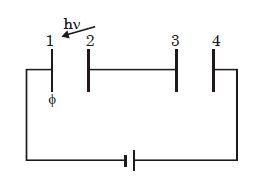
Two identical capacitors are arranged as shown. Work function of plate $1$ is $\phi  \ eV$ .The $emf$ of battery is $\frac{\phi }{e}$ . If energy of incident photon is $hv$ then maximum kinetic energy of $e^-$ reaching plate $2$ is 
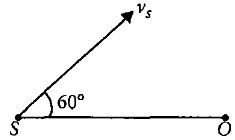
A source of sound $S$ emitting waves of frequency $100\,\, Hz$ and an observer $O$ are ocated at some distance from each other. The source is moving with a speed of $19 .4\,\, m s^{-1}$ at an angle of $60^o $ with the source observer line as shown in the figure. The observer is at rest. The apparent frequency observed by the observer .... $Hz$ (velocity of sound in air $330 \,\, m s^{-1}$), is 
The focal length of objective and eye-piece of a telescope are $100\, cm$ and $5\, cm$ respectively. Final image is formed at least distance of distinct vision. The magnification of telescope is
A big circular coil of $1000$ turns and average radius $10\,m$ is rotating about its horizontal diameter at $2\,rad.s ^{-1}$. If the vertical component of earth's magnetic field at that place is $2 \times 10^{-5}\,T$ and electrical resistance of the coil is $12.56 \,\Omega$, then the maximum induced current (in $A$) in the coil will be :
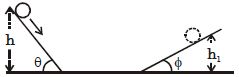
A demonstration apparatus on a table in the lab is shown in diagram. It consists of a metal track (shown as a thick solid line in the figure below) along which a perfectly spherical marble which can roll without slipping. In one run, the marble is released from rest at a height h above the table on the left section, rolls down one side and then up the other side without slipping, briefly stopping when it has reached $h_1$. Assuming the table to be horizontal and neglecting air drag as well as any energy loss due to rolling,
A lens of power $+ 2$ diopters is placed in contact with a lens of power $-1$ diopter. The combination will behave like
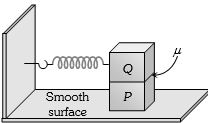
$A$ block $P$ of mass m is placed on a frictionless horizontal surface. Another block Q of same mass is kept on $P$ and connected to the wall with the help of a spring of spring constant k as shown in the figure. ${\mu _s}$ is the coefficient of friction between$  P$ and $ Q$. The blocks move together performing SHM of amplitude $A$. The maximum value of the friction force between $P$ and $Q$ is
A tuning fork arrangement (pair) produces $4$ beats/sec with one fork of frequency $288\, cps$. A little wax is placed on the unknown fork and it then produces $2\; beats/sec$. The frequency of the unknown fork is  .... $cps$
When a metallic surface is illuminated with monochromatic light of wavelength $l$, the stopping potential is $5$ $V_0$. When the same surface is illuminated with light of wavelength $3 \lambda $, the stopping potential is $V_0$. Then the work function of the metallic surface is :
A body of mass $1\, kg$ is under a force, which causes a displacement in it is given by $x = \frac{{{t^3}}}{3}$ (in $m$). Find the work done by the force in first second ............ $\mathrm{J}$